
by: Dan Price, Broker at Team Price Real Estate
Austin's leading data analysis brokerage, where data drives exceptional service
Published on: Thursday, April 09 2026 at 7:05 am
The single most telling number in this week's Austin real estate data is straightforward: the median sold price inside the City of Austin is $550,000, down $40,000 from $590,000 a year ago. That 6.8% year-over-year decline is the sharpest price drop in the dataset and it reflects what buyers and sellers inside the city limits are actually experiencing right now. The broader Austin-Area MLS is softer too, but at a much slower pace. Understanding the difference between those two stories is the key to reading this market correctly in April 2026.
Download the Full Weekly PDF Report below.
The complete Team Price weekly report covers 885 pages of Austin-area market data including absorption rates, activity indexes, days on market, price-per-square-foot trends, and city and ZIP code breakdowns. Download the full report.
How Is Inventory Trending Across the Austin-Area MLS?
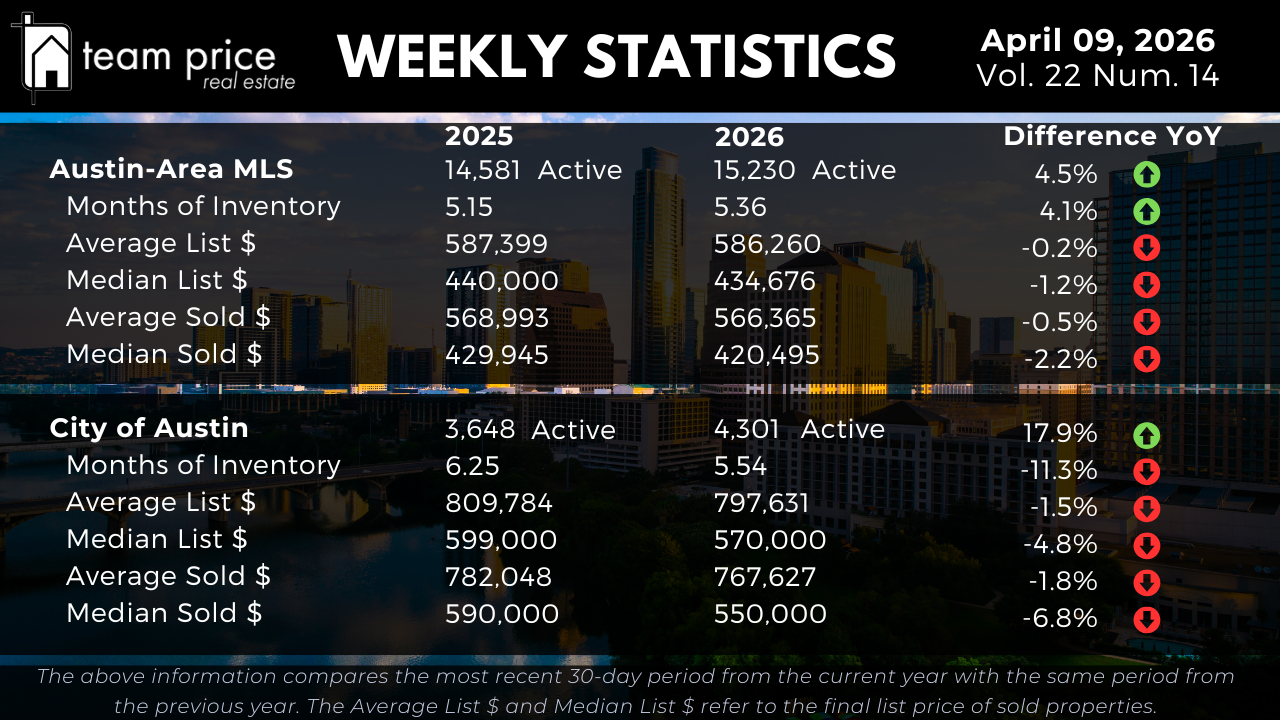
Austin-area housing inventory is up 4.5% year over year. There are 15,230 active listings on the market today compared to 14,581 at this point in 2025, a net increase of 649 homes. Months of inventory for the Greater Austin MLS is 5.36, up from 5.15 a year ago, a 4.1% increase. Supply is growing, demand is not keeping pace, and that imbalance is the engine behind the gradual price softening showing up across every metric.
Inside the City of Austin, the inventory picture is more dramatic. Active listings climbed from 3,648 to 4,301, a 17.9% year-over-year increase. Despite that, months of inventory in the city actually declined, dropping from 6.25 to 5.54. More homes are selling in absolute terms, which pulled the supply figure down even as listings rose. The city is moving product, but it is doing so by competing on price.
What Are Austin-Area MLS Home Prices Doing Right Now?
Austin-area home prices are declining modestly across every category when compared to the same 30-day period last year. The average list price of sold properties in the Austin-Area MLS is $586,260, down 0.2% from $587,399. The median list price is $434,676, down 1.2% from $440,000.
On closed sales, the average sold price is $566,365, a 0.5% decline from $568,993 a year ago. The median sold price is $420,495, down 2.2% from $429,945. These are not alarming figures in isolation, but the consistency of direction across all four metrics is notable. Every number is lower than it was at this point in 2025, and the median is declining faster than the average, which suggests the softening is more concentrated in the mid-market than at the high end.
What Is Happening to Home Prices in the City of Austin?
City of Austin home prices are declining at a meaningfully faster pace than the metro average. The average list price of sold properties is $797,631, down 1.5% from $809,784. The median list price is $570,000, down 4.8% from $599,000. On closed sales, the average sold price is $767,627, a 1.8% decrease from $782,048. The median sold price is $550,000, down 6.8% from $590,000.
That 6.8% year-over-year drop in the median sold price is the headline. The median is the cleanest measure of what a typical buyer is paying, and it is down $40,000 from where it stood twelve months ago. Sellers inside the city limits are accepting less, buyers are negotiating harder, and the gap between where sellers want to be and where buyers will go has moved in buyers' favor.
Are Austin Buyers Getting Homes Below the Asking Price?
The sold-to-list price ratio across the Austin-Area MLS is 97.31% this month, meaning the average sold property closes at roughly 97 cents on every dollar of final list price. Looking at the full distribution, 65.39% of homes closed under list price this month. That is nearly unchanged from 65.36% in March, meaning the pattern is stable.
The movement worth watching is at the extremes. Properties closing over list price rose from 13.12% last month to 16.25% this month, and that figure is also up from 15.37% in April 2025. Properties selling at exactly list price declined from 21.52% last month to 18.36% this month. What that pattern suggests is that the market is polarizing. Well-positioned homes are drawing competitive interest and closing above ask. Homes that are priced wrong or in softer locations are sitting and eventually closing under list. The middle ground of at-list closings is shrinking, and the spread between the best-performing and worst-performing listings is getting wider.
How Are Prices Moving Across Central Texas Cities and ZIP Codes?
Across the 30 cities tracked in Central Texas, 12 or 40% posted a month-over-month price increase. Seventeen or 57% declined. Year over year, 11 cities or 37% are showing gains while 19 or 63% are down. From their 12-month peak, just 4 cities have moved higher. Twenty-six have declined.
Across the 75 tracked ZIP codes, 33 or 44% posted a month-over-month increase while 38 or 51% declined. Year over year, 32 ZIP codes or 43% are up and 43 or 57% are down. From their 12-month price peak, only 6 ZIP codes are above peak. Sixty-nine are below.
That breadth of decline across Central Texas real estate is meaningful context. Price softening is not isolated to one city or one price tier. More than half of tracked geographies are losing ground both month over month and year over year. Buyers working in any of the 69 ZIP codes below their 12-month peak have a structural negotiating advantage that did not exist in 2022 or 2023.
What Is the Outlook for the Austin Housing Market in Spring 2026?
The spring 2026 Austin housing market is defined by two competing signals, and both are real. Prices are declining year over year across the metro, with the City of Austin leading the correction at 6.8% on the median sold price. At the same time, above-list-price closings rose from 13.12% to 16.25% in a single month, and pending listings across the Austin-Area MLS are up 2.9% year over year, both of which point to genuine buyer activity.
The reconciliation between those two signals is that the market is not stuck — it is active and selective. Correctly priced homes in sought-after locations are moving and sometimes drawing competition. Overpriced homes or homes in softer ZIP codes are sitting until sellers adjust. With 69 of 75 ZIP codes below their 12-month price peak and 63% of tracked cities declining year over year, the weight of the data still favors buyers. That does not mean every seller is in a difficult position, but it does mean that pricing strategy matters more now than at any point since the correction began.
If this PDF does not display, click here to open in a new tab .
Q&A: Austin Real Estate Questions — April 2026
Are home prices dropping in Austin TX in 2026?
Yes, Austin home prices are declining year over year as of April 2026. The median sold price in the City of Austin is $550,000, down 6.8% from $590,000 a year ago. Across the broader Austin-Area MLS, the median sold price is $420,495, down 2.2% from $429,945. Every major pricing metric — average list, median list, average sold, median sold — is lower than it was at this point in 2025. The pace of decline is gradual and orderly, not a sudden drop, but the direction has been consistent for an extended period.
Is it a buyer's market in Austin right now?
By most measures, yes. Months of inventory at 5.36 across the Austin-Area MLS and 5.54 inside the city both sit at the upper end of what analysts consider balanced territory, which tends to shade conditions toward buyers. More than 65% of homes are closing below list price. Sixty-nine of 75 tracked ZIP codes are below their 12-month price peak. That said, a meaningful share of well-priced homes — around 16% of all closings this month — are still generating enough demand to close above list price. It is a buyer's market in aggregate, but not uniformly so across every location and price point.
How much have Austin home prices fallen from the peak?
From the May 2022 peak, the Austin-Area MLS median sold price has fallen $91,000 or 16.9%, from $538,000 to $447,000. The City of Austin median sold price has dropped $131,500 or 19.3%, from $680,000 to $548,500. On a per-square-foot basis, the Austin-Area MLS median is down 21.4% from its April 2022 peak, and the City of Austin median per square foot is down 24.7% from its April 2022 peak. These corrections have been distributed over four years rather than compressed into a single event.
Why are City of Austin home prices falling faster than the suburbs?
The City of Austin entered the correction with higher absolute prices and a larger inventory overhang relative to demand. Active listings inside the city jumped 17.9% year over year, a rate of increase nearly four times the broader metro. When supply rises that fast, sellers compete on price. The suburbs are not immune — 63% of tracked Central Texas cities are down year over year — but the magnitude of the correction is sharpest where prices ran up the most and where the supply-demand imbalance is most pronounced.
What percentage of Austin homes sell over asking price in April 2026?
In April 2026, 16.25% of homes across the Austin-Area MLS closed above the final list price. That is up from 13.12% in March 2026 and also above the 15.37% recorded in April 2025. So while the majority of homes — 65.39% — are still closing under list, the competitive segment of the market is modestly more active than it was a year ago. Homes generating above-list closings tend to be accurately priced, well-prepared, and located in areas with constrained supply relative to local demand.
Is spring 2026 a good time to buy a home in Austin?
The data makes a reasonable case for buyers who are ready to move. The median sold price in the City of Austin is $40,000 lower than it was a year ago. Sixty-nine of 75 tracked ZIP codes are below their 12-month price peak, meaning buyers have structural room to negotiate in most of the market. The sold-to-list ratio of 97.31% confirms that final sale prices are running about 2.7% below asking on average. Inventory is up 4.5% metro-wide, giving buyers more options than they had in 2024 or 2023. None of that guarantees the right outcome on any individual transaction, but the market conditions in aggregate favor buyers more clearly in spring 2026 than they have in several years.
Published April 9, 2026. Dan Price, Broker, Team Price Real Estate.