When Austin's Market Splits in Two: 2 Hot Zips, 2 Cold Zips, and 71 in the Middle
The Austin metro real estate market today looks less like a single market and more like a barbell. Out of 75 zip codes tracked across the Austin metro, only four sit at the extremes — two are running hot for sellers, and two have gone cold. Every single one of them is inside the city of Austin. Not one suburb made either list. The remaining 71 zip codes are clustered in the middle, with 56 percent classified as Balanced and another 13 percent leaning Warm. For an Austin housing market that has spent the last several years swinging between historic highs and dramatic corrections, today's snapshot tells a story of a region that has largely found its footing — except in a handful of neighborhoods where the math has gone in opposite directions.
The Distribution Tells the Real Story
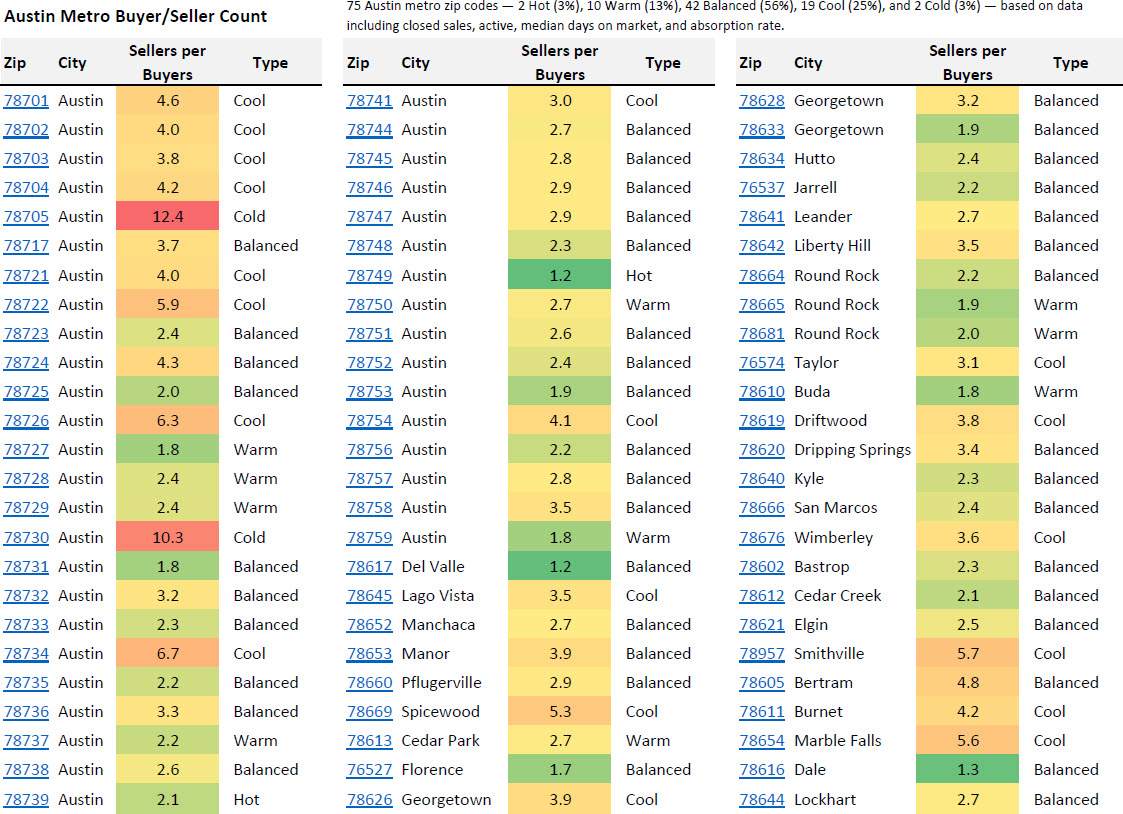
Before zooming in on the extremes, the broader Austin real estate market deserves attention. Of the 75 zip codes analyzed, 42 are classified as Balanced, representing 56 percent of the metro. Another 19 zip codes (25 percent) are Cool, 10 are Warm (13 percent), 2 are Hot (3 percent), and 2 are Cold (3 percent). That distribution matters because it shows the Austin housing market today is not uniformly favoring buyers or sellers. Most neighborhoods are functioning closer to equilibrium, where neither side dominates negotiations. The Austin real estate trends visible in this composite are a sharp departure from the runaway seller's market of 2021 and the buyer-leaning conditions that followed in 2023 and 2024.
What stands out is geographic concentration. Every zip code in Round Rock, Georgetown, Pflugerville, Cedar Park, Leander, Hutto, Kyle, Buda, Manor, Liberty Hill, Dripping Springs, Bastrop, Elgin, San Marcos, and the rest of the suburban ring falls somewhere between Warm and Cool. The suburbs, as a group, are the Austin property market's stabilizing force right now. The volatility lives downtown and in the urban core.
The Two Hot Zip Codes: 78749 and 78739
The hottest zip code in the Austin metro today is 78749, with a sellers-per-buyer ratio of 1.2. This zip covers the Circle C, Maple Run, and Legend Oaks neighborhoods in Southwest Austin — established, family-oriented communities with strong school zoning and limited new inventory. A 1.2 ratio means there are roughly six sellers for every five buyers, which in composite terms places it at the top of the Austin housing market for seller leverage right now.
The second Hot designation goes to 78739, the Circle C Ranch and surrounding Southwest Austin area, with a 2.1 ratio. While the raw ratio is higher than several zip codes classified as Balanced, the Hot label comes from a composite score that weighs additional market indicators beyond the buyer-to-seller count alone. Both Hot zip codes share a profile: Southwest Austin, family-driven demand, Austin ISD or Eanes-adjacent schools, and limited turnover. These are the neighborhoods where the Austin home prices story remains most resilient.
The Two Cold Zip Codes: 78705 and 78730
On the opposite end, 78705 is the coldest zip code in the Austin metro with a 12.4 sellers-per-buyer ratio. That is more than ten times the ratio in 78749. Geographically, 78705 covers West Campus and the area immediately surrounding the University of Texas. This is a structurally unique submarket dominated by condos, student-oriented housing, and investor-owned units. The cold reading reflects a confluence of factors that don't apply to typical owner-occupied neighborhoods: heavy investor inventory, condo oversupply, and a buyer pool that skews toward a narrow demographic.
The second Cold zip is 78730, the Northwest Hills and River Place area, with a 10.3 ratio. This is a higher-priced submarket where luxury inventory tends to move more slowly during periods of elevated mortgage rates. When buyers in the upper price tiers pull back, zip codes like 78730 absorb the slowdown disproportionately. Both Cold zip codes are inside the city of Austin, and both reflect submarket dynamics — student housing oversupply on one end, luxury price sensitivity on the other — rather than a broader weakness in the Austin real estate market.
Why the Suburbs Are the Quiet Story
The most overlooked finding in this Austin housing market update is what didn't happen: no suburb showed up at either extreme. Round Rock, Georgetown, Cedar Park, Pflugerville, Leander, Hutto, Kyle, Buda, Liberty Hill, Dripping Springs, Manor, Bastrop, San Marcos, Wimberley, Lockhart, Smithville, Bertram, Burnet, Marble Falls, and the rest of the suburban metro all sit in the Balanced, Warm, or Cool range. The hottest suburb is 78610 Buda at a 1.8 ratio, classified Warm. The coldest suburb is 78957 Smithville at 5.7, classified Cool — nowhere near 78705's 12.4.
This suburban stability is meaningful for the Austin real estate forecast. It suggests that the Austin metro's growth ring continues to absorb demand at a steady pace, with buyer-seller dynamics that don't swing wildly from one zip to the next. For agents and consumers tracking Austin real estate trends, the suburbs are operating as a kind of pressure release valve — neither overheating nor going cold.
What This Means for Buyers and Sellers
For buyers, the takeaway is that 94 percent of the Austin metro is currently in Warm, Balanced, or Cool territory. That means most negotiations today happen on something close to even ground, with neither party holding overwhelming leverage. Buyers shopping in 78705 or 78730 may find unusual opportunity given the sellers-per-buyer imbalance. Buyers targeting 78749 or 78739 should expect more competition and less room to negotiate.
For sellers, the message is to know your zip. Pricing strategy in a Hot zip differs fundamentally from pricing in a Cold zip, and pricing in a Balanced zip — which describes more than half the market — requires a calibrated approach that reflects actual buyer demand rather than headlines about the broader Austin property market.
FAQ
What does "sellers per buyer" mean in the Austin housing market?
The sellers-per-buyer ratio measures how many active sellers exist for every active buyer in a given zip code. A ratio of 1.0 means equal supply and demand. Ratios below 2.0 generally indicate a competitive seller's environment, while ratios above 6.0 typically signal buyer-favorable conditions. In the current Austin real estate market, the metro-wide range runs from 1.2 in the Hot zip 78749 to 12.4 in the Cold zip 78705 — a tenfold spread that highlights how localized Austin real estate trends have become.
Why are the hottest and coldest Austin zip codes all inside the city of Austin?
The city of Austin contains the metro's most distinctive submarkets — luxury enclaves, student housing zones, and established family neighborhoods with constrained inventory. These structural differences create wider swings in the Austin housing market than the more uniform suburban communities, where housing stock, buyer demographics, and inventory levels tend to be more consistent. Suburbs like Round Rock, Cedar Park, and Georgetown all currently sit in the Balanced or Warm range, while the city of Austin contains every Hot and Cold zip in the metro.
Is the Austin real estate market a buyer's market or a seller's market right now?
Neither label applies to the Austin metro as a whole. Today's data shows 56 percent of zip codes are Balanced, 13 percent are Warm, 25 percent are Cool, and only 6 percent sit at the Hot or Cold extremes. The Austin property market is functioning closer to equilibrium than at any point in recent years, though specific zip codes can deviate sharply from the metro average. The Austin real estate forecast depends heavily on which neighborhood is being analyzed.
What makes zip code 78705 the coldest in Austin?
Zip code 78705 covers West Campus and the area surrounding the University of Texas. This submarket is structurally different from typical owner-occupied neighborhoods — it is dominated by condominiums, student-oriented housing, and investor-owned properties. The 12.4 sellers-per-buyer ratio reflects an oversupply of inventory relative to the limited buyer pool, rather than a broader weakness in the Austin housing market. Buyers seeking value in central Austin may find unusual opportunity here.
How are Austin's hottest zip codes classified when raw ratios overlap?
The Hot, Warm, Balanced, Cool, and Cold classifications are based on a composite score that incorporates the sellers-per-buyer ratio along with additional market indicators. That is why 78739, with a 2.1 ratio, can be classified Hot while several zip codes with lower ratios are classified Balanced. The composite approach captures momentum and conditions that a single-metric analysis would miss, producing a more accurate picture of Austin real estate trends at the neighborhood level.