Austin Housing Market Update – September 2025: Sold-to-List Ratio at 14-Year Low
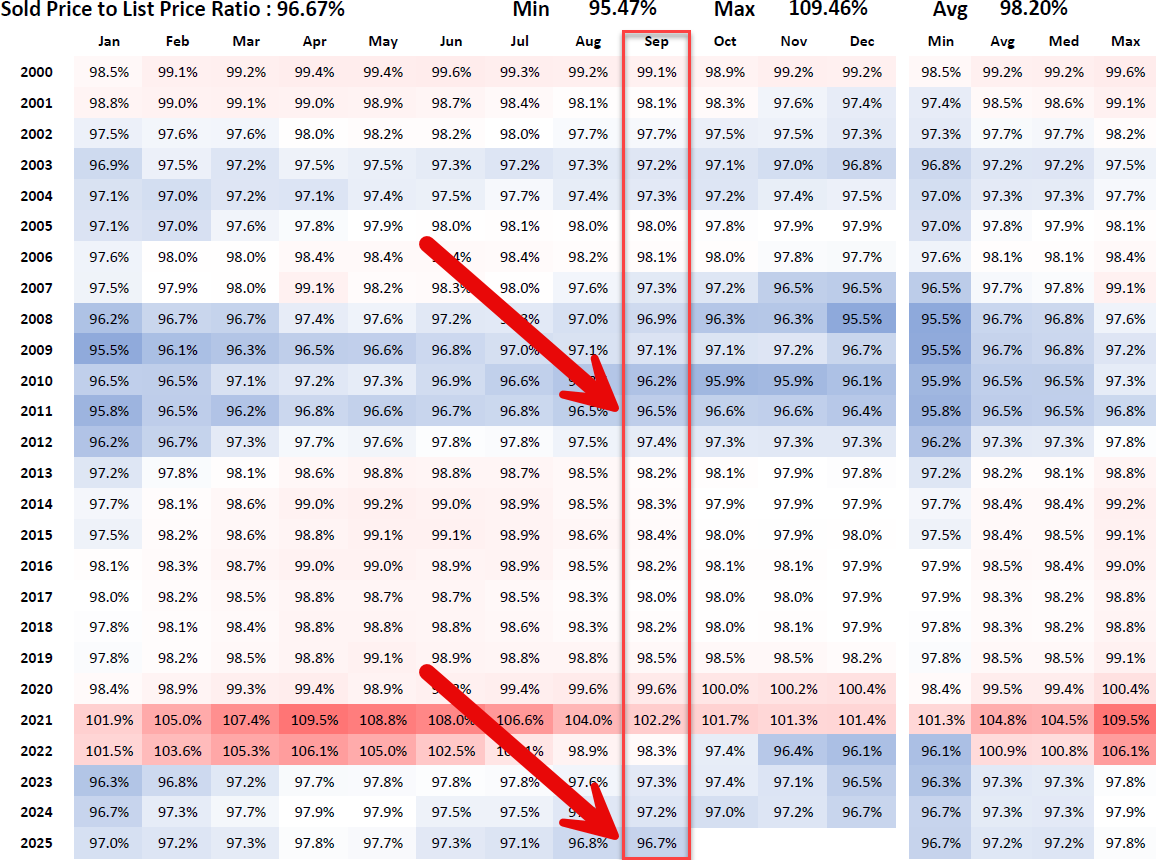
The Austin housing market just recorded its weakest September negotiation strength in over a decade. With a sold-to-list price ratio of 96.7%, this marks the lowest September result since 2011, when the ratio also hovered around 96.5%. This shift tells a clear story: buyers have gained the upper hand. For the third straight year, the Austin real estate market has moved further from the overheated frenzy of 2021 and closer to conditions last seen in the post-recession cycle of the early 2010s. Sellers who once commanded multiple offers over asking are now conceding an average discount of more than three percent off list price to secure a sale.
Market Overview
The sold-to-list price ratio is one of the most reliable signals of market balance. In 2021, the Austin real estate market peaked with homes selling well above list price—averaging 109.5% in April 2021, meaning buyers routinely bid tens of thousands over asking. By late 2022, that ratio had already fallen back to the high 90s, and in 2023 and 2024, September readings were 97.3% and 97.2% respectively. Now, at 96.7% in September 2025, the market has completed a three-year progression of buyer advantage. For perspective, between 2012 and 2019, Austin home prices consistently sold within one to two percent of list price, reflecting steady competition. Today’s gap is larger, underscoring how far negotiating power has swung.

Housing Prices and Buyer Behavior
The decline in the sold-to-list ratio pairs with a broader reset in Austin home prices. Compared to peak conditions in 2021–2022, today’s Austin housing market reflects a more restrained environment. Buyers are not rushing to outbid one another, and they’re successfully negotiating price reductions. A ratio of 96.7% means a home listed at $500,000 is now more likely to sell closer to $483,500. This isn’t just anecdotal—data confirms that discounts are built into today’s closings, and pricing strategy has become a critical factor for sellers. Overpricing leads to extended days on market and larger concessions at closing.
Regional Trends
While the city of Austin remains the most visible part of the property market, suburban and surrounding county data reflect similar trends. Across the Austin real estate market, buyers expect room to negotiate. The sold-to-list ratio dropping to levels not seen since 2011 suggests that this is not a one-off seasonal dip but rather part of a structural correction. The 2010–2011 cycle offers a useful comparison. Back then, ratios around 96–97% marked a recovery phase after the Great Recession. The difference today is that Austin home prices are correcting after a historic surge rather than a credit-driven crash. Still, the outcome for buyers—more leverage at the table—is strikingly similar.
List-to-Sale Price Performance
The September 2025 ratio of 96.7% aligns closely with ratios from late 2009 through 2011, when the market was working through excess supply. What makes the current cycle notable is the speed of the swing: from over 109% in April 2021 to under 97% today in just four years. This change highlights how Austin housing trends can pivot sharply when affordability, interest rates, and inventory converge. Unlike in 2020–2021, when scarcity and cheap credit drove buyers to overpay, the 2025 environment rewards patient and disciplined purchasing.
Peak Value Trends
The long arc of Austin real estate shows clear cycles. From 2000 through 2019, ratios rarely strayed below 97%. Then came the pandemic surge, when Austin home prices outpaced fundamentals and ratios soared well above list. The return to sub-97% readings in 2023–2025 represents a reversion to historical norms. For investors and market forecasters, this is a sign that the Austin property market is rebalancing. Price growth may resume in the future, but for now, the correction phase is still unfolding, and data suggests it could extend further before stabilizing.
Conclusion
September 2025’s sold-to-list price ratio of 96.7% sends a clear message: the Austin real estate market has shifted decisively toward buyers. This is the lowest September ratio in 14 years, marking a sustained departure from the overheated highs of 2021. Sellers who hope to close deals in this environment must price with precision and remain flexible. Buyers, on the other hand, should view this as an opportunity to enter negotiations from a position of strength.
Scroll down to view the full Austin Daily Real Estate Briefing PDF for October 2, 2025.
FAQ
1. What does a sold-to-list price ratio of 96.7% mean in Austin real estate?
It means that, on average, homes in Austin sold for 3.3% below their asking price in September 2025. For example, a home listed at $600,000 would close closer to $580,200. This ratio reflects buyer leverage in negotiations and signals a cooling market.
2. How does this compare to Austin housing trends in recent years?
In 2021, homes often sold well above asking, peaking at 109.5% in April. By September 2023 and 2024, ratios had slipped to 97.3% and 97.2%. The latest 96.7% reading confirms a continued downward trend in the Austin real estate market.
3. Why is the 96.7% ratio significant for the Austin property market?
It is the lowest September reading since 2011. Historically, ratios this low only occurred during the post-recession recovery. The current figure shows that today’s market is undergoing a structural correction similar in magnitude to that period.
4. What does this mean for Austin home prices going forward?
A lower ratio suggests that Austin home prices may remain under pressure. Buyers are securing discounts, and sellers are conceding value to close deals. This environment often persists until inventory tightens or demand strengthens.
5. How should buyers and sellers adjust strategies in today’s Austin housing market?
Buyers should take advantage of leverage, negotiate confidently, and focus on properties priced realistically. Sellers should avoid overpricing, as homes that start too high often sit longer and ultimately sell for less. Correct pricing upfront is the best way to compete in today’s market.
Keep reading other bits of knowledge from our team.
Have a question about this article or want to learn more?