Buda Housing Market Update: The Correction, the Reset, and What 2026 Is Likely to Bring
Buda is still in a correction, and the data makes that plain. After the 2021–2022 surge, prices have been working lower for three straight years, and the market is now running far below peak levels. If you want to understand where the Buda segment of the Austin real estate market sits today, this dataset gives you the full story from 2001 to early 2026, including the boom, the pullback, and what “bottoming” would need to look like to be real.
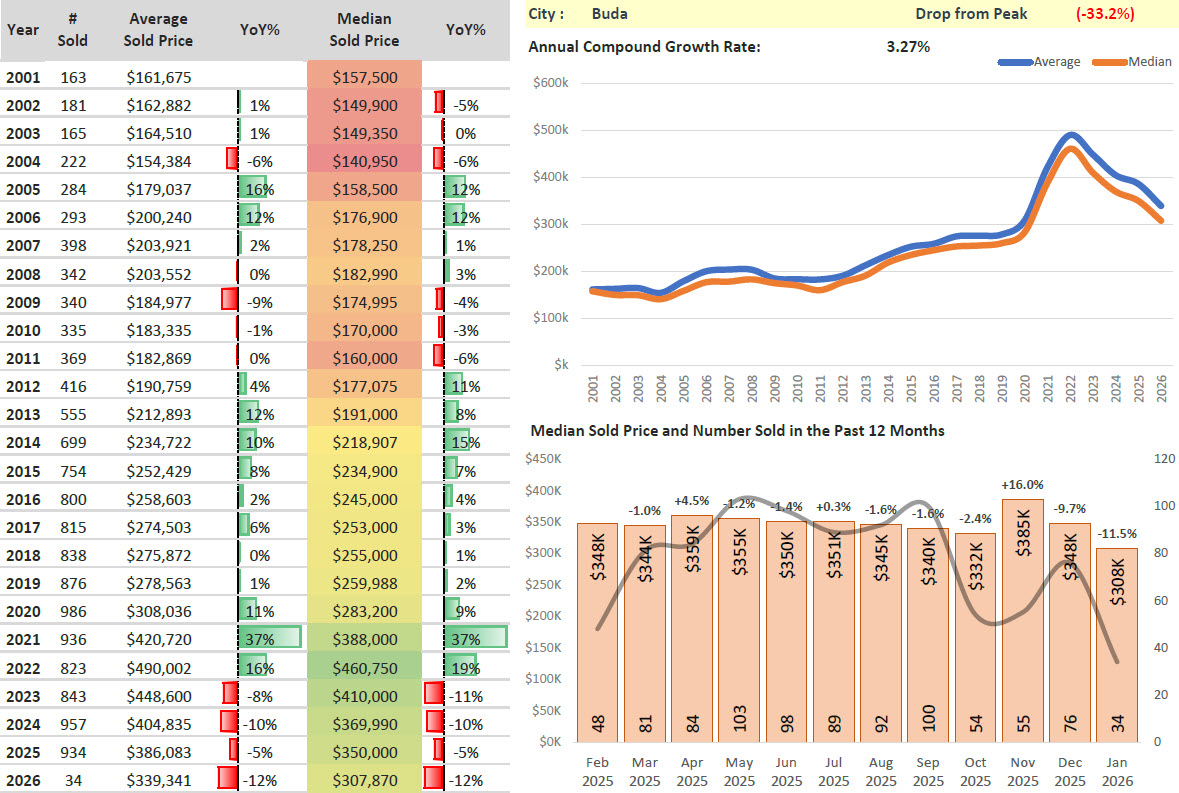
Buda’s long-run trend is steady, not explosive. The annual compound growth rate shown here is 3.27%, which is what a normal, durable appreciation path looks like over decades. From the early 2000s through the mid-to-late 2010s, pricing climbed with normal cycle pauses, including a clear dip in the 2009–2011 window, and then a re-acceleration starting around 2012. That long-term stability matters, because it sets expectations for how markets behave after a bubble phase: they usually do not snap back quickly, they normalize slowly.
The bubble phase in Buda is concentrated in 2021 and 2022, and it was extreme. Median sold price jumped from $283,200 in 2020 to $388,000 in 2021, a 37% year-over-year move. Then it climbed again to $460,750 in 2022, another 19% year-over-year increase. That kind of two-year surge is not “healthy momentum.” It is a price discovery shock, and the market almost always has to unwind part of it once rates and affordability tighten.
That unwind is exactly what happened. Median sold price fell to $410,000 in 2023, then $369,990 in 2024, then $350,000 in 2025. Early 2026 is tracking even lower, with a median sold price of $307,870 and a year-over-year decline of 12% shown in the dataset. From peak to current, the dashboard flags a 33.2% drop from peak. In plain English, Buda has already given back about one-third of its peak pricing level. That is a real correction, not a minor dip.
Average prices confirm this is not just a “mix shift” story. In 2022, the average sold price is shown at $490,002. Early 2026 shows an average sold price of $339,341. When both median and average fall hard across multiple years, that points to broad price pressure, not just fewer high-end homes selling.
Sales volume adds an important second layer. The number of homes sold in Buda remained relatively resilient even while prices corrected. Closings were 823 in 2022, 843 in 2023, 957 in 2024, and 934 in 2025. That tells you transactions are happening, but only at lower clearing prices. That is a classic pattern in a resetting market: demand exists, but it is price sensitive and requires the market to come to the buyer rather than the buyer chasing the market.
The past 12 months chart gives you the “feel” of the market month-to-month, and it is choppy. Median sold price held in the mid-$340Ks to mid-$350Ks through much of 2025, dipped to $332K in October 2025, spiked to $385K in November, then returned to $348K in December and dropped to $308K in January 2026. That November pop looks more like composition than a turning point, because it immediately reversed. The January print is the bigger signal: $308K median with only 34 sold, which is a weak combination of price and volume even allowing for January seasonality.
So is 2026 the year prices bottom out in Buda? The honest answer from this dataset is: it’s possible, but the market has not proven it yet. A bottom is not one low month. A bottom is a pattern where declines stop, months stabilize into a tight band, and year-over-year pricing compresses toward flat. Right now, early 2026 still shows a negative year-over-year number. That means the market is still in the “finding the floor” phase rather than the “building a new base” phase.
In the context of the broader Austin housing cycle, this is what you should expect operationally. Sellers who price off 2022 comps are typically going to chase the market down through reductions, because the market has already moved. Buyers have leverage, but it is leverage that must be used with discipline, because the trend has been down long enough that the market can still reprice lower if affordability remains tight. For agents, the job is less about hype and more about precision: pricing strategy, comp selection, and negotiation structure are the difference between getting a deal done and sitting stale.
The clearest takeaway is this: Buda is no longer in a rapid appreciation environment. It is in a correction and normalization environment. The long-term CAGR suggests the market’s natural tendency is steady growth over time, but the near-term reality is that the post-peak reset is still underway. If 2026 becomes the bottom, you will see stabilization first, not a rebound first.
Is 2026 the bottom year? Using only this data, the most defensible call is: 2026 is more likely a “bottoming process” than a clean bottom year. A clean bottom typically shows YoY declines shrinking toward zero and then flipping positive after a sustained flat period. Early 2026 still shows -12% YoY, so the market is not there yet.
FAQ
Is now a good time to buy in the Austin real estate market if I’m focused on Buda?
If you’re focused on Buda, the data shows the market is meaningfully below peak pricing, with the dashboard indicating a 33.2% drop from the 2022 peak. That creates better entry points than the 2021–2022 period, but buyers should treat this as a correction environment, not a rebound environment. The most durable “buy” decision is one where the payment is comfortable and the price makes sense relative to recent closed sales, not peak-era comps. These are among the most common buyer questions in Austin-area housing discussions.
Will Austin home prices bottom out in 2026?
For Buda specifically, the data shows pricing is still trending down early in 2026 with a -12% year-over-year signal, which is not what a confirmed bottom looks like yet. Bottoming is a pattern of stabilization over multiple months, followed by year-over-year numbers compressing toward flat. Based on this dataset alone, 2026 could be part of the bottoming process, but the market has not proven the turn. This “bottom or not” question is consistently asked in Austin housing market forecast content.
How far are Buda prices from the peak, and what does that mean for sellers?
The dashboard explicitly shows Buda is down 33.2% from peak, and the median moved from $460,750 in 2022 to $307,870 in early 2026. For sellers, that means pricing off 2022 comps is usually a mistake; it increases the odds of reductions and extended time on market. The market is clearing, but it is clearing at lower price points than the peak.
What is the difference between average and median sold price, and why does it matter in a correction?
Median shows the middle sale, which reduces distortion from a handful of high-end closings, while average can swing more based on the mix of homes sold. In this dataset, both average and median are down hard from 2022 to early 2026, which suggests broad market repricing, not just a change in which types of homes sold. That’s important because it supports the conclusion that the correction is widespread.
What should I watch in 2026 to know the market has stabilized?
Using this dataset’s structure, watch three things: the year-over-year column moving toward zero, the monthly medians tightening into a narrower band without fresh lows, and sales volume staying steady while pricing stops declining. Stabilization is not a single month; it is a multi-month pattern where sellers stop chasing the market down and buyers stop demanding ever-lower pricing to transact. Questions like this show up frequently in “market update” style Austin real estate reporting.