Short Sales Doubled. 2,477 Distressed Properties Lurk Behind the Curtain.
By Dan Price | Team Price Real Estate | March 2026
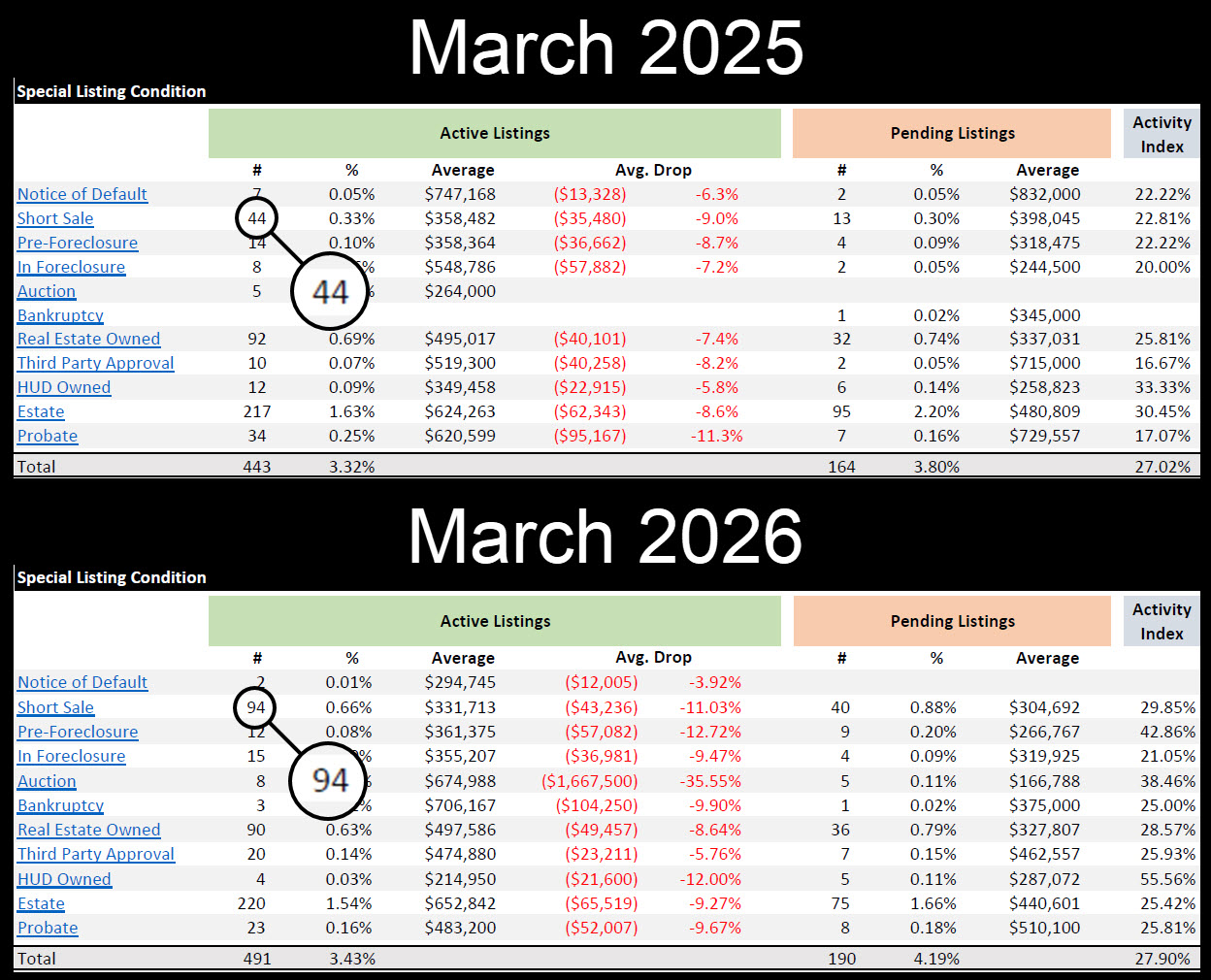
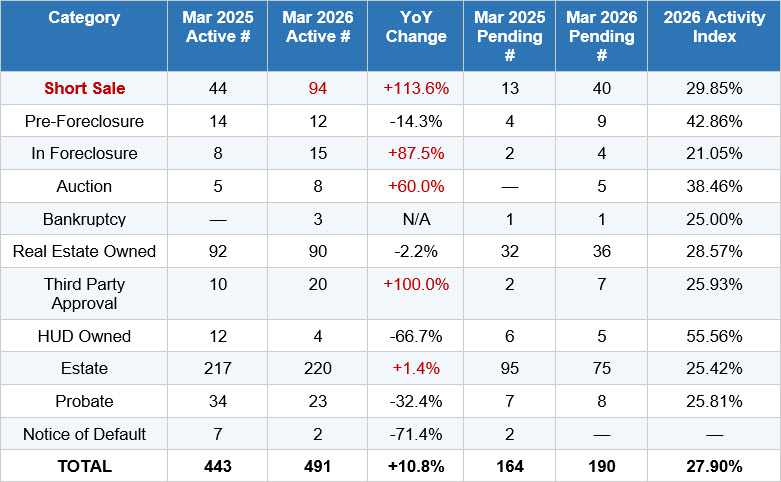
The Austin real estate market is sending a signal that most buyers and sellers aren't seeing yet. Short sale listings in the Austin MSA — covering Travis, Williamson, Bastrop, Hays, Caldwell, and Burnet counties — have doubled in just twelve months. There were 44 active short sale listings on the MLS in March 2025. In March 2026, that number stands at 94. That's a 113.6% year-over-year increase, and it's just the beginning of what the full data reveals.
When you pull back the curtain and look beyond the MLS to public tax records, the picture becomes dramatically more striking. Across the Austin MSA, there are currently 2,477 properties classified as distressed — in pre-foreclosure, headed to auction, or already bank-owned. Of those, only a fraction have surfaced on the MLS. The gap between what exists in the public record and what is actively listed for sale raises a critical question: is Austin's housing market in the early stages of a distressed property wave, or are there structural reasons why so much inventory remains hidden?
What Is a Short Sale?
A short sale occurs when a homeowner sells their property for less than the outstanding balance on their mortgage, and the lender agrees to accept the reduced payoff rather than proceed to foreclosure. The term "short" refers to the shortfall between what is owed and what the home sells for — not the length of the transaction.
Short sales are often a last resort for homeowners who are underwater on their mortgage, facing financial hardship, and trying to avoid the credit damage of a full foreclosure. For lenders, it is frequently a preferred outcome because it avoids the cost and complexity of the foreclosure process. For buyers, short sales can represent an opportunity to acquire property below market price — but they come with longer timelines and additional layers of lender approval that conventional sales do not require.
In March 2026, the 94 active short sale listings in the Austin MSA carried an average listing price of $331,713, down from $358,482 in March 2025. Sellers are already dropping prices by an average of $43,236 — an 11.03% reduction — just to attract offers. That discount has deepened from the 9.0% average price cut recorded a year ago. The 40 pending short sales this month, up from 13 in March 2025, suggest buyer demand for these discounted properties is growing.
Understanding Pre-Foreclosure
Pre-foreclosure is the earliest stage of the foreclosure process. It begins when a homeowner falls behind on mortgage payments and the lender files a public notice — often called a Notice of Default or Lis Pendens — signaling that the loan is in default. The homeowner still owns the property at this stage and has options: they can cure the default by catching up on payments, negotiate a loan modification, arrange a short sale, or surrender the property to foreclosure.
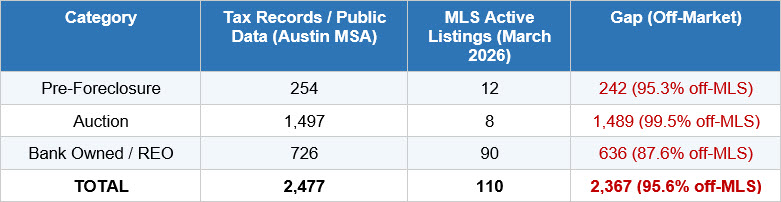
Pre-foreclosure properties are significant in market analysis because they represent homeowners under financial pressure who have not yet been forced to sell. Public tax records show 254 properties in pre-foreclosure status across the Austin MSA right now. On the MLS, only 12 pre-foreclosure properties are actively listed. That means roughly 95% of homeowners currently in pre-foreclosure have not yet listed their homes for sale. Whether they will — and how quickly — is one of the key unknowns shaping the Austin housing market outlook over the next 12 to 18 months.
What Happens at Auction?
When a borrower cannot resolve a default and the lender completes the foreclosure process, the property is typically sold at a public auction — also called a trustee's sale or sheriff's sale, depending on the state. In Texas, foreclosure auctions are held on the first Tuesday of each month at county courthouses. Bidders must usually pay in cash, and properties are sold as-is with no inspection period or contingencies.
The auction stage represents properties where the lender has already given up on workout options. These are the most advanced distressed listings in the pipeline. The numbers here are the most dramatic in the Austin MSA data: public tax records identify 1,497 properties currently categorized as auction-status. The MLS shows just 8 active auction listings. That is a gap of 1,489 properties — 99.5% of the auction pipeline is invisible to buyers searching on the MLS.
Some of these properties may not ultimately sell at auction — lenders occasionally pull listings back, modify loans at the last minute, or fail to attract minimum bids. But the volume of 1,497 properties moving toward trustee sale in a single metro area is not a number that can be dismissed. If even a fraction of these properties proceed through auction and re-enter the market as bank-owned inventory, the supply implications for the Austin housing market would be measurable.
Bank Owned / REO Properties
When a property fails to sell at auction — either because no bidder met the minimum bid or the lender did not attract any offers — the lender takes title to the property. These homes are then classified as REO, or Real Estate Owned. Banks and mortgage servicers generally want to liquidate REO properties as efficiently as possible, since carrying vacant homes generates ongoing costs with no offsetting revenue.
Public tax records show 726 bank-owned properties across the Austin MSA. On the MLS, 90 properties are listed under the Real Estate Owned category — meaning 636 bank-owned homes, or 87.6% of the total, are not yet actively listed for sale. Banks may be managing these in batches, preparing them for sale, negotiating bulk dispositions, or simply processing the paperwork required before listing. But the inventory exists, and it is substantial.
The timeline for REO properties to move from bank ownership to active MLS listing varies. Some lenders list quickly to minimize carrying costs; others are slower moving. In either case, the 726 bank-owned properties in the Austin MSA represent a meaningful shadow inventory that could reshape the supply picture if it enters the market within a compressed timeframe.
The Full Distressed Pipeline: MLS vs. Public Record
The table above captures the scale of the gap between publicly recorded distressed activity and what is visible to buyers on the MLS. Across all three major distressed categories — pre-foreclosure, auction, and bank-owned — the Austin MSA contains 2,477 properties in some form of financial stress. Only 110 of those properties appear as active MLS listings. That leaves 2,367 properties, or 95.6% of the distressed total, entirely off-market.
All Special Listing Conditions: March 2025 vs. March 2026
Total active special listing condition properties across the Austin MSA grew from 443 in March 2025 to 491 in March 2026 — an increase of 10.8% year-over-year. The overall Activity Index, which measures the ratio of pending to active listings and signals how quickly distressed inventory is absorbing, edged up from 27.02% to 27.90%. While that movement is modest, the composition of what is driving the increase matters more than the aggregate total.
Will Short Sales Continue to Rise?
The 113.6% year-over-year jump in short sale active listings — from 44 to 94 — did not happen in a vacuum. It reflects a specific set of conditions: homeowners who are underwater on mortgages acquired during the 2021–2022 price peak, rising holding costs, limited refinancing options in a higher rate environment, and a resale market that has not recovered to peak values in many Austin submarkets.
The pre-foreclosure data on the public record strongly suggests the short sale count on the MLS has further room to grow. With 254 homeowners currently in the pre-foreclosure stage, a share of those will ultimately list as short sales if they cannot cure their defaults through other means. The increase in pending short sales — from 13 to 40 — indicates that lenders are approving more short sale transactions, which often takes several months of negotiation. That pipeline will produce more closings in the months ahead.
Third Party Approval listings — a category that often captures transactions requiring lender consent, similar in nature to short sales — doubled from 10 to 20 active listings year-over-year. Combined with the broader pre-foreclosure pipeline, the directional trend across multiple distressed categories points toward continued growth in short sale activity throughout 2026.
Why Is the Gap Between Tax Records and MLS So Large?
The disparity between the 2,477 distressed properties on public record and the 110 visible on the MLS is a function of how the foreclosure and disposition process works in practice. Pre-foreclosure filings are public notices, not listings. The vast majority of homeowners who receive a Notice of Default never list their home on the MLS — some resolve the default, some negotiate directly with their lender, and some simply wait, hoping conditions change.
Auction properties present a different dynamic. Texas foreclosure auctions are conducted outside the MLS entirely. The 1,497 properties classified as auction-status in public records are scheduled or pending trustee sales — they will be offered at county courthouse steps, not through a real estate agent. When no buyer appears at auction, the lender takes the property as REO, which is when it may eventually appear on the MLS.
Bank-owned properties often spend months in the REO pipeline before being listed. Lenders must clear title, assess the property condition, assign it to an asset management team, and sometimes make basic repairs before marketing the home. The gap between the 726 bank-owned properties on record and the 90 listed on the MLS is therefore not a permanent condition — but the timeline for those 636 unlisted homes to surface is uncertain.
For buyers and agents tracking the Austin real estate market, the implication is significant: the MLS tells only part of the story. The distressed inventory that will eventually flow through the market is substantially larger than current active listings suggest.
What This Means for Buyers and Sellers
For buyers, the doubling of short sales and the scale of the off-market distressed pipeline represent both opportunity and complexity. Short sales and REO properties are often priced below market, but they require patience, cash reserves for as-is purchases in some cases, and an understanding that timelines are less predictable than conventional transactions. Buyers willing to navigate these conditions may find acquisition opportunities in an Austin market that has otherwise remained relatively stubborn on pricing.
For sellers, the data is a sober reminder that competition is not limited to what appears on the MLS today. If even a portion of the 2,477 distressed properties in the public record moves to market over the next 12 to 18 months, it will add supply pressure to a market that has already seen inventory levels climb. Sellers who need to move in 2026 should price competitively and understand that the landscape is likely to become more challenging, not less, as the year progresses.
The Austin housing market is not in a crisis — but the data is telling a story that deserves close attention. Short sales have doubled. The distressed pipeline is deep. And the gap between what exists on public record and what is visible on the MLS suggests the full weight of this inventory has not yet reached the market.
Frequently Asked Questions
What is a short sale in Austin real estate, and how does it work?
A short sale in Austin real estate occurs when a homeowner sells their property for less than the balance remaining on their mortgage, and the mortgage lender agrees to accept the reduced payoff amount. The process requires the seller to prove financial hardship, submit a short sale package to the lender — including financials, a hardship letter, and a purchase offer — and then wait for lender approval before the sale can close. In Austin, short sales are typically priced below comparable non-distressed listings to attract buyer interest. As of March 2026, active short sale listings in the Austin MSA carry an average listing price of $331,713, with sellers already accepting an average price reduction of $43,236, or 11.03%, to generate offers. The lender's approval can take anywhere from 30 days to several months, making short sales a longer process than conventional transactions.
Are short sales increasing in the Austin housing market?
Yes, short sales are increasing meaningfully in the Austin housing market. Active short sale listings across the Austin MSA grew from 44 in March 2025 to 94 in March 2026 — a 113.6% year-over-year increase. Pending short sales rose even more sharply, from 13 to 40, indicating that lender approvals are accelerating and more transactions are moving toward closing. The average price drop required to generate a short sale offer deepened from 9.0% to 11.03% over the same period, reflecting greater seller urgency and lender flexibility. The broader pre-foreclosure data — 254 properties currently in that stage across the Austin MSA — suggests continued growth in short sale listings is likely as more homeowners who cannot resolve defaults pursue this exit option.
How many distressed properties are in the Austin MSA, and why aren't they all on the MLS?
As of March 2026, public tax records across the Austin MSA — covering Travis, Williamson, Bastrop, Hays, Caldwell, and Burnet counties — identify 2,477 properties in distressed classifications: 254 in pre-foreclosure, 1,497 heading to auction, and 726 bank-owned. Of those, only 110 appear as active MLS listings. The gap exists because the foreclosure and disposition process does not automatically produce MLS listings. Pre-foreclosure filings are legal notices, not listings. Texas foreclosure auctions happen at county courthouses outside the MLS entirely. And bank-owned properties typically spend months in an internal asset management process before being assigned to a listing agent. The 95.6% of distressed properties currently off-MLS represent a shadow inventory that will gradually surface over time, though the timing is uncertain.
What does the Austin foreclosure auction process look like, and can buyers participate?
In Texas, foreclosure auctions — formally called trustee's sales — are held on the first Tuesday of each month at county courthouse locations. Buyers can participate, but the process is very different from purchasing a home through the MLS. Properties sell as-is with no inspection period, no title insurance guarantee, and no financing contingency — most purchases require cash payment on the day of the auction. Buyers must research titles independently before bidding to identify any liens or encumbrances that may transfer with the property. As of March 2026, public records show 1,497 properties in auction status across the Austin MSA, though only 8 appear on the MLS in this category. The gap reflects that the vast majority of foreclosure auctions in Texas occur entirely outside the MLS system.
Should sellers in Austin be concerned about distressed property competition in 2026?
Sellers in the Austin real estate market should be aware of the growing distressed property pipeline, though its impact will be gradual rather than sudden. With 2,477 distressed properties in the public record and only 110 currently on the MLS, a meaningful volume of additional inventory could enter the market over the next 12 to 18 months as bank-owned properties are listed, short sales increase, and auction properties that fail to sell convert to REO. This additional supply, concentrated in the under-$400,000 price band where short sale and REO averages cluster, could add downward price pressure in that segment. Sellers in higher price bands may feel less direct impact, but the overall direction of Austin housing market inventory is upward, and pricing competitively in 2026 is more important than it was in 2022 or 2023.