Austin Rental Market Report
Austin Rental Market Reaches Highest March Inventory Level Since 2005
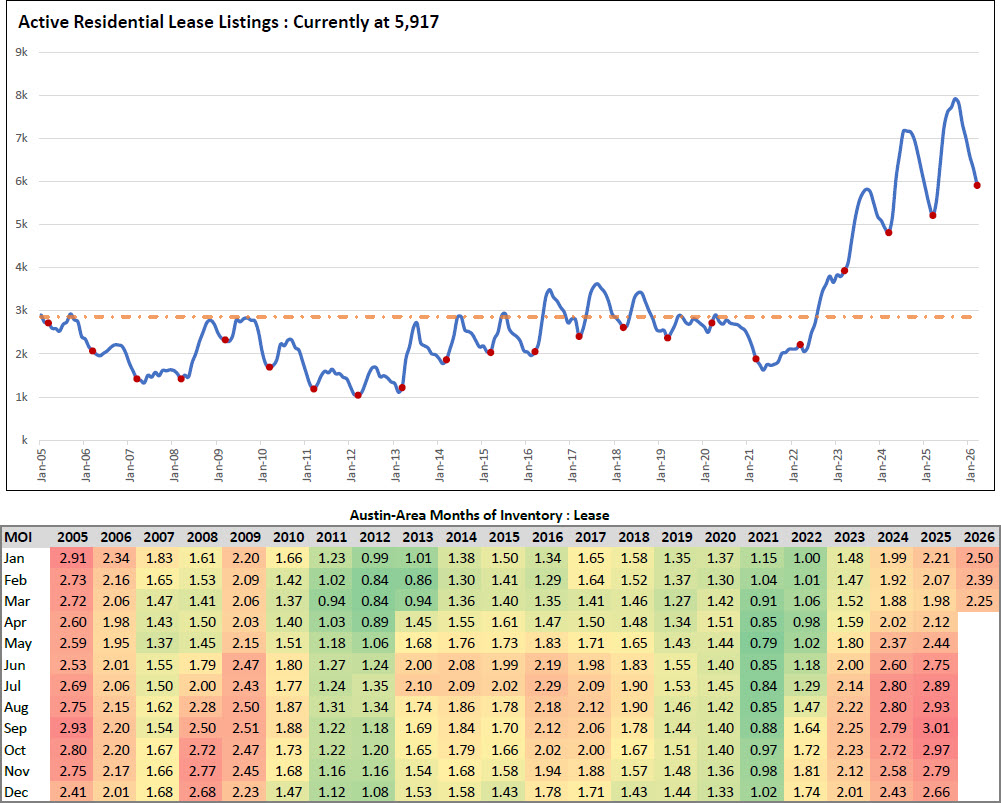
The Austin rental market is carrying more supply this March than it has in two decades. Months of inventory for active residential lease listings hit 2.25 in March 2026, the highest reading for that month since 2005, when the figure stood at 2.72. With 5,917 active residential lease listings currently on the market — nearly double the historical baseline of roughly 2,800 to 3,000 — renters in the Austin area have more options and more negotiating power than at any point in recent memory. For landlords and property investors, the data signals a rental market that has shifted firmly in favor of tenants.
How March 2026 Compares to 20 Years of Data
The lease months of inventory dataset covers every March from 2005 through 2026, giving a complete 21-year picture of Austin rental market conditions. March 2026 at 2.25 months ranks second in that entire history, behind only March 2005 at 2.72. The next closest comparables are March 2006 and March 2009, both at 2.06 months. Every other March on record came in below 2.0 months, and many fell well below that threshold. March 2021 hit a historic low of just 0.91 months, the tightest rental supply environment in the dataset, when pandemic-era demand surged and new construction had not yet caught up.
The climb from that 2021 floor has been consistent and steep. March 2022 was 1.06. March 2023 rose to 1.52. March 2024 reached 1.88. March 2025 came in at 1.98. And now March 2026 stands at 2.25 — a 147% increase from the 2021 low in just five years. That trajectory reflects the sustained wave of new multifamily construction that has delivered rental supply into the Austin market faster than demand has been able to absorb it, a pattern that has played out consistently across all months of the calendar.
2026 Is Running at the Highest Levels Since 2005 Across All Three Months
March is not an isolated data point. Every month of 2026 tracked so far has set a post-2005 high for its respective month. January 2026 came in at 2.50, the highest January reading since January 2005 at 2.91. February 2026 reached 2.39, the highest February since 2005's reading of 2.73. The consistency across all three months of the year so far confirms this is not a one-month anomaly but a sustained market-wide condition. The Austin rental market in early 2026 is operating at a level of inventory that has not been seen since the mid-2000s, when the city was a fraction of its current size.
The significance of that comparison deserves context. Austin in 2005 was a much smaller market with far fewer rental units in circulation. A months of inventory reading of 2.25 today, against a backdrop of nearly 6,000 active lease listings, represents a materially larger pool of available units than the same figure would have in 2005. In practical terms, renters today have more absolute choices than any comparable period in Austin real estate history, even if the ratio metric alone does not fully capture that scale.
Active Lease Listings at 5,917 — Nearly Double the Historical Baseline
The active lease listing count of 5,917 puts current supply in stark visual relief against the long-run baseline. For most of the period from 2005 through 2020, Austin's active residential lease inventory hovered in a range of roughly 2,800 to 3,000 listings, represented by the flat historical reference line in the data. The market began its dramatic climb after 2021, peaking at approximately 7,800 active lease listings in the 2024 to 2025 period before pulling back to the current 5,917. That pullback from the peak suggests some moderation is underway, but the current count still represents roughly twice the pre-pandemic baseline.
The trajectory from the 2021 low of approximately 1,600 active lease listings to today's 5,917 is one of the most dramatic supply expansions in the Austin rental market's recorded history. New multifamily development, conversion of for-sale inventory to rental listings, and softening demand from remote work normalization and cost-of-living migration all contributed to the buildup. The question now is whether supply continues to moderate from its 2024 to 2025 peak or whether another wave of new deliveries keeps inventory elevated through the remainder of 2026.
What This Means for Renters and Landlords
For renters, the current Austin rental market presents conditions that favor negotiation. With 5,917 active listings and months of inventory at the highest March level since 2005, landlords are competing for a more limited pool of qualified tenants than at any point in the past two decades outside of 2005 and the brief 2009 softening. Concessions, rent reductions, and flexible lease terms are more available now than during the tight 2021 to 2022 window, when inventory fell below 1 month and landlords held nearly all the leverage.
For landlords and investors, the data calls for realistic pricing and a clear-eyed view of competition. At 2.25 months of inventory in March, the Austin rental market is not in crisis — it is not the 11-month buyers market environment seen in some for-sale zip codes — but it is unambiguously a renter-friendly market by historical standards. Properties that are priced at or below comparable market rates and presented well are still leasing. Properties that are overpriced relative to the available competition are sitting. The market is separating quality, well-priced inventory from everything else, and that dynamic is likely to persist through the spring and summer leasing season.
The Bigger Picture for Austin Housing Trends
The Austin rental market does not exist in isolation from the broader Austin real estate market. With 14,881 active for-sale listings and a median months of inventory of 6.07 across 75 zip codes, both the purchase and rental sides of the Austin housing market are carrying elevated supply simultaneously. That is a meaningful shift from the 2021 to 2022 period, when both markets were extremely tight. Renters who might consider buying are navigating high mortgage rates and an ample for-sale inventory. Buyers who might consider renting while they wait face a rental market that is also well-supplied. The overall effect is a more balanced Austin housing environment than the region has experienced in years, with supply outpacing demand across both tenure types.
Frequently Asked Questions About the Austin Rental Market
What is months of inventory in the Austin rental market?
Months of inventory in the Austin rental market measures how long it would take to lease all currently active residential listings at the current absorption pace, assuming no new listings are added. A lower number indicates a tighter, landlord-favored market where demand exceeds supply. A higher number indicates a tenant-favored market with more options and less competition for available units. The Austin rental market has historically run between 1.0 and 2.0 months of inventory for most of the period from 2005 through 2022. The current reading of 2.25 months in March 2026 is the highest for that month since 2005, reflecting the sustained buildup of rental supply that began in earnest after 2021.
Is the Austin rental market a good market for renters right now?
By the data, yes. March 2026 marks the highest lease months of inventory for that month since 2005, and all three months of 2026 tracked so far have set post-2005 highs for their respective months. With 5,917 active residential lease listings — nearly double the historical baseline of 2,800 to 3,000 — renters have significantly more options than during the 2021 to 2022 period, when inventory fell below 1,600 listings and months of inventory hit a record low of 0.91 in March 2021. Current Austin rental market conditions favor tenants in terms of selection, pricing pressure on landlords, and availability of concessions. That said, well-located, well-priced units in tight suburban corridors may still lease quickly.
Why has Austin rental inventory increased so much since 2021?
The surge in Austin rental market inventory from its 2021 low reflects a combination of factors that converged after the pandemic. A wave of multifamily construction that was planned during the 2018 to 2020 period began delivering units in large numbers starting in 2022 and 2023. At the same time, demand softened as remote work normalization reduced migration into the Austin area, and affordability pressures pushed some prospective renters out of the market entirely. Rising mortgage rates also meant fewer renters transitioned to homeownership, keeping more renters in the pool but also reducing absorption. The result was a rapid buildup from approximately 1,600 active lease listings in early 2021 to a peak of roughly 7,800 in 2024 to 2025, before the current partial moderation to 5,917.
How does Austin's rental market compare to historical norms?
Austin's rental market is running well above historical norms by the months of inventory measure. For most of the period from 2006 through 2022, March months of inventory ranged from 0.84 to 2.06, with the majority of readings below 1.5. The current March 2026 reading of 2.25 is not only above that typical range but is the second highest March figure in 21 years of data. Active listing counts tell the same story: the long-run baseline of approximately 2,800 to 3,000 active lease listings compares to today's 5,917, meaning current supply is running at roughly double the historical norm in absolute terms. The Austin rental market is in a historically elevated supply environment.
Will Austin rental inventory continue to rise or start to fall in 2026?
The data suggests some moderation is already underway. Active lease listings have pulled back from a peak of approximately 7,800 in the 2024 to 2025 period to the current 5,917, a meaningful decline from the high. However, months of inventory continues to set post-2005 highs on a month-by-month basis in 2026, indicating that the pace of absorption has not yet caught up with supply. Whether inventory continues to decline will depend on the rate of new multifamily deliveries in the Austin area, the strength of renter demand as the spring and summer leasing season progresses, and broader economic conditions affecting household formation and migration into the region. Based on current Austin real estate trends, the rental market is more likely to remain elevated through 2026 than to return quickly to the pre-2022 baseline.