The Rate of Homes Selling Over List Price Just Hit a 12-Month High
If you have been watching the Austin real estate market and waiting for a signal that buyer conditions are shifting, March 2026 is delivering one. The percentage of Austin-area homes selling over list price has climbed to 14.29% — the highest reading in 12 months, surpassing both the 13.1% recorded in March 2025 and every month since April 2025, when the rate briefly touched 14.9%. That number is still well below the 26-year historical average of 20.92%, which means buyers continue to operate in a structurally favorable environment. But the direction of movement matters. After two full years of compressed over-list activity, the data is ticking upward — and in at least one Austin-area city, the rebound is already dramatic.
Understanding What 'Sold Over List Price' Actually Tells You
The percentage of homes selling over list price is one of the most direct measures of buyer-seller leverage in any real estate market. When this number is high, sellers hold the power: multiple offers are common, buyers are waiving contingencies, and homes routinely close above asking price. When it is low, the dynamic flips. Buyers can negotiate, sellers must compete with their own price adjustments, and the risk of overpaying shrinks considerably.
In the Austin real estate market, this metric has a 26-year history that puts today's readings in sharp perspective. The all-time low in the dataset is 8.95%, and the all-time high is 72.62% — a peak reached during April 2021 at the height of the pandemic-era frenzy, when nearly three out of four homes in the Austin market sold above asking price. The 26-year average of 20.92% reflects a market that, historically, has leaned modestly in favor of sellers. At 14.29% today, Austin is running about 6.6 percentage points below that long-run average — a meaningful gap that continues to favor buyers on a historical basis, even as momentum nudges upward.
The 26-Year Context: How We Got Here
To appreciate what 14.29% means for the Austin housing market, it helps to trace the full arc of this metric across more than two decades. Through most of the 2000s, the rate of homes selling over list price ranged between roughly 16% and 25%, with seasonal peaks in spring and summer. The 2008 financial crisis dragged the metric into the low teens and it remained depressed through 2012, bottoming at a monthly low of 9.6% in October 2011 — the weakest reading of the post-crisis recovery period.
The recovery that followed was gradual but persistent. By 2013 and 2014, spring peaks were pushing back above 25%, and by 2015 and 2016, June was regularly topping 30%. Then came 2020, when pandemic-driven demand and historically low mortgage rates lit the fuse on what became one of the most extreme seller's market episodes in Austin real estate history. The rate climbed from 17% in January 2020 to 38.2% by December of that year — and then kept going. In 2021, the monthly readings ranged from 45% to 72.6%, averaging 58.5% for the full year. In plain terms, nearly six in ten Austin home sales closed above asking price for an entire calendar year.
The unwind was equally dramatic. By the second half of 2022, the over-list rate collapsed — from 64.7% in March to 11.6% by December — as rising mortgage rates rapidly repriced buyer demand. The full year 2022 averaged 40.2%, a misleading figure skewed heavily by the first-half carry from 2021 momentum. By 2023 and 2024, Austin real estate had settled into a new, much lower equilibrium. The 2023 full-year average was 13.7%. The 2024 full-year average was 12.5%. The 2025 full-year average came in at 12.1%. March 2026's reading of 14.29% now represents the first meaningful uptick above that two-year plateau.
March 2026: The Highest Reading in 12 Months
The current Austin housing market reading of 14.29% is notable for several reasons beyond the headline number. It is the highest monthly figure since April 2025, when the metric briefly reached 14.9% before fading back into the 10% to 13% range for the remainder of that year. It also comfortably clears March 2025's reading of 13.1%, making this March the strongest March in the post-correction era on a year-over-year basis.
Seasonality plays a role worth acknowledging. March and April have historically been among the most active months in the Austin real estate market, as spring buying season drives competition and multiple-offer situations become more common. Looking at the historical data, March readings have consistently exceeded the preceding December and January readings in most years. The question for 2026 is whether this March uptick represents a seasonal bounce that fades back into the 10% to 12% range by summer, or whether it marks the beginning of a more sustained recovery toward the historical mean of 20.92%. The data is not yet definitive, but the direction is worth watching closely.
City-Level Divergence: Manor Surges, Pflugerville Struggles
The metro-wide figure of 14.29% obscures significant variation at the city level — and two of those city-level stories are moving in opposite directions. The City of Manor is currently posting a 12-month high over-list rate of 23.1%, a reading that stands nearly 9 percentage points above the Austin metro average and signals genuine competitive demand in that market. Manor's performance is particularly notable given the broader environment. For a city in the Austin metro to be running at 23.1% while the metro aggregate sits at 14.29% indicates that Manor-area buyers are encountering meaningful seller-side competition — multiple offers, properties moving quickly, and likely less room for below-list negotiation than in surrounding markets.
Pflugerville tells the opposite story. At 9.1%, the city is approaching its 12-month low, with only the December 2025 reading of 7.1% having been weaker over that span. March 2026 represents the second-lowest month in the past year for Pflugerville — a signal that buyer competition there remains subdued and that sellers are not commanding above-list premiums with any consistency. For buyers specifically targeting Pflugerville, the current data continues to support a negotiating posture rather than a competitive bidding posture.
The City of Austin proper sits at 16.2% — above the metro average of 14.29% but below the historical norm of 20.92%. This reading suggests the urban core is outperforming the broader metro in terms of seller leverage, consistent with the pattern seen in most major cities where core neighborhoods maintain stronger demand relative to outlying suburbs during market normalization periods.
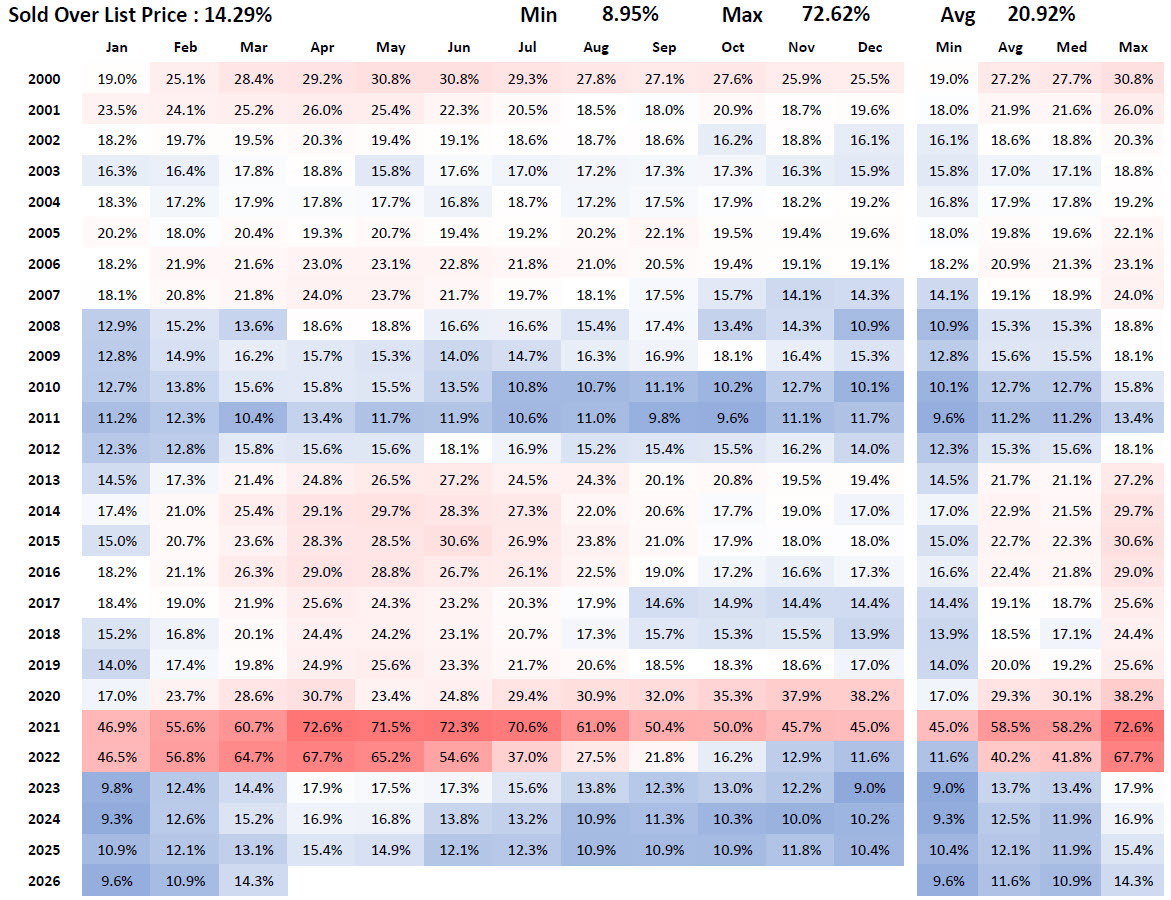
Austin Real Estate Market Data: Sold Over List Price — 26-Year Historical Table (2000–2026)
The table below presents the complete monthly and annual summary data for the percentage of Austin-area homes selling over list price from 2000 through March 2026. The highlighted row represents the current year. The 2021 and 2022 rows reflect the pandemic-era peak and correction. The 26-year historical average is 20.92%.
Note: Highlighted row (2026) reflects partial year data through March. All figures represent the percentage of closed home sales in the Austin metro area that sold at or above the original list price. 26-year historical average: 20.92%. All-time low: 8.95%. All-time high: 72.62% (April 2021).
What This Data Means for Austin Home Buyers Right Now
For buyers active in the Austin real estate market today, the 14.29% over-list rate is a double-edged data point. On one hand, the fact that it represents a 12-month high and is trending upward is a signal that competition is building — at least seasonally. Spring 2026 appears to be following the historical pattern of elevated buyer activity. On the other hand, at nearly 7 percentage points below the 26-year average, buyers are still operating in conditions that are structurally more favorable than the long-run norm.
The city-level data adds important precision for buyers deciding where to focus. Pflugerville at 9.1% remains one of the most buyer-friendly environments in the metro — sellers in that market are not routinely receiving over-list offers, which translates to real negotiating leverage on price and terms. The City of Austin at 16.2% and Manor at 23.1% represent progressively tighter conditions. Buyers targeting Manor in particular should be prepared for competition and should not assume the same level of negotiating latitude that exists in Pflugerville or even in the broader metro.
What This Data Means for Austin Home Sellers Right Now
For sellers, the March 2026 reading is moderately encouraging but does not signal a return to peak conditions. At 14.29%, the probability that a well-priced Austin home will attract an over-list offer is meaningfully lower than the 20.92% historical average — which means pricing strategy remains critical. Sellers who price at or slightly below market are most likely to benefit from the current seasonal uptick in buyer activity. Sellers who push above market value in hopes of capturing a bidding war are operating against the data: the over-list rate would need to sustain meaningfully above 20% before that strategy becomes broadly effective.
The Manor market is the exception to this characterization. A 23.1% over-list rate at a 12-month high suggests that correctly priced Manor homes have a real chance of generating competitive offers in the current environment. Sellers in that market have more pricing confidence than their counterparts in Pflugerville, where the data continues to argue for conservative list pricing and realistic expectations around where buyers will actually transact.
Frequently Asked Questions
What percentage of Austin homes sell over list price right now?
As of March 2026, 14.29% of Austin-area homes are selling over list price — the highest reading in 12 months and above the 13.1% recorded in March 2025. However, this figure remains well below the 26-year historical average of 20.92% for the Austin real estate market, indicating that buyers continue to operate in conditions that are more favorable than the long-run norm. The reading reflects a seasonal uptick consistent with spring buying activity, though it is too early to confirm whether this represents a sustained trend toward the historical average.
Is the Austin housing market a buyer's market or seller's market in 2026?
The Austin real estate market in 2026 is best described as a buyer-leaning neutral market at the metro level. With 14.29% of homes selling over list price — roughly 6.6 percentage points below the 26-year average of 20.92% — buyers retain structural advantages in negotiation, particularly in suburban markets like Pflugerville where the over-list rate is just 9.1%. However, specific submarkets are tightening. Manor is posting a 23.1% over-list rate at a 12-month high, reflecting genuine seller-side competition in that city. Conditions vary significantly by price tier and geography, making hyperlocal data more actionable than metro-wide averages.
How does the current Austin over-list sale rate compare to the pandemic peak?
The contrast is substantial. In April 2021 — the peak of the pandemic-era Austin housing frenzy — 72.62% of homes sold over list price. The full-year 2021 average was 58.5%, meaning more than half of all Austin home sales closed above asking price for an entire year. Today's reading of 14.29% is roughly 58 percentage points below that peak. The correction from peak to the current normalized environment largely played out over the second half of 2022, when the over-list rate collapsed from 64.7% in March to 11.6% by December as rising mortgage rates rapidly changed buyer behavior. The Austin housing market has now been in a low over-list environment for approximately three full years.
Which Austin-area cities have the highest and lowest rates of homes selling over list price?
Among tracked Austin-area cities, Manor currently leads with a 23.1% over-list rate — a 12-month high that signals active buyer competition in that market. The City of Austin proper sits at 16.2%, above the metro average but below the historical norm. Pflugerville is near the opposite end of the spectrum at 9.1%, just above its 12-month low of 7.1% recorded in December 2025, making it one of the most buyer-favorable markets in the metro right now. These city-level divergences highlight why metro-wide averages can be misleading — buyers and sellers in different parts of the Austin market are experiencing meaningfully different competitive conditions.
What is a normal rate of homes selling over list price in Austin?
Based on 26 years of Austin real estate market data from 2000 through 2026, the long-run average rate of homes selling over list price is 20.92%. The historical range spans from a low of 8.95% to a peak of 72.62% reached during the April 2021 pandemic boom. In the pre-pandemic era from 2000 through 2019, annual averages typically ranged between roughly 17% and 23%, with spring months consistently posting higher readings than winter months. The current reading of 14.29% is below that pre-pandemic normal range, which reinforces the buyer-favorable characterization of today's Austin housing market despite the recent 12-month high.