Austin Real Estate Market: 3.3 Sellers for Every Buyer — But Not Every Zip Code Is the Same
By Dan Price | Team Price Real Estate | teamprice.com
Published April 15, 2025 | Austin Metro Market Snapshot
Austin's Housing Market Is Balanced — But the Zip Code Next Door Tells a Different Story
Right now, across the Austin real estate market, there are 3.3 sellers for every buyer. That single number tells you a lot. It means there is more supply than demand, but not so much that the market is in freefall. Based on a composite analysis covering all 75 zip codes in the Austin metro area, the overall market is classified as Balanced — a condition where neither buyers nor sellers hold a clear and dominant advantage. But if you are buying, selling, or investing, that metro-wide number can be dangerously misleading.
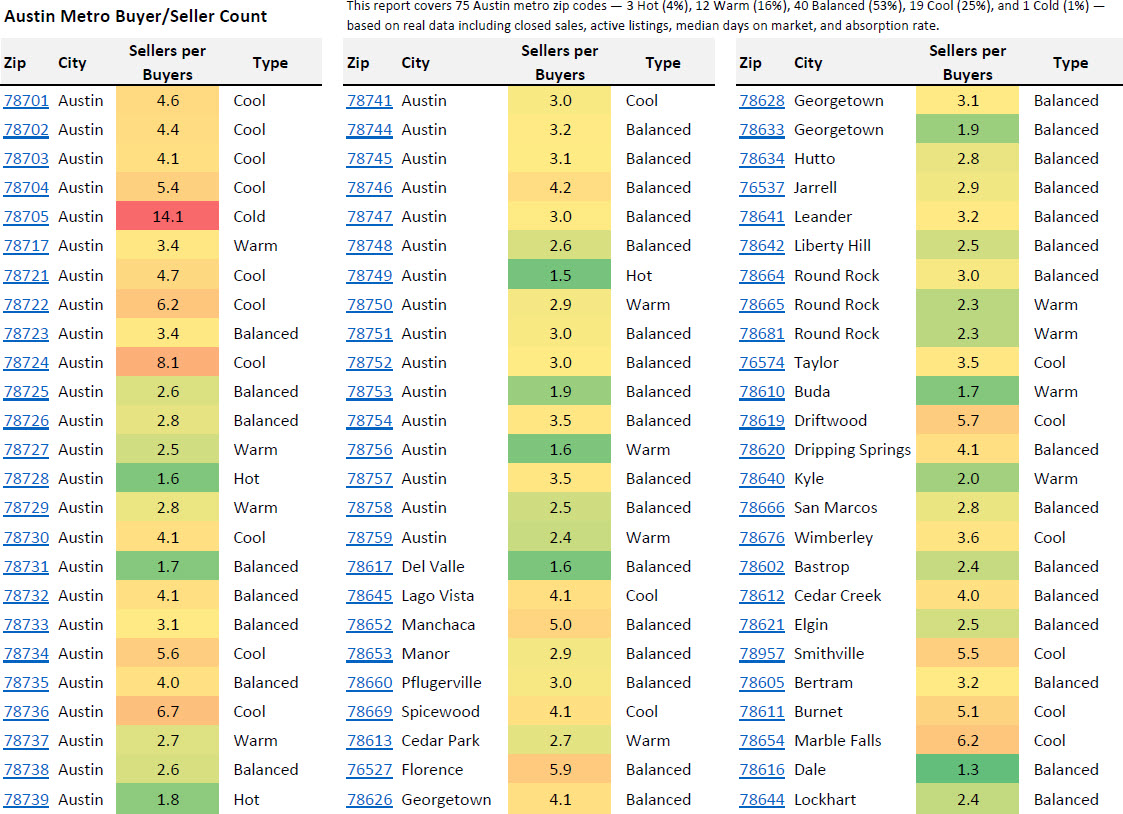
This report analyzes 75 Austin metro zip codes using a composite scoring model that weighs three demand signals: the Activity Index, the Absorption Rate, and the Sellers per Buyer ratio. Each is normalized to a common scale and averaged into a single score from 0 to 100. Markets scoring 80 or above are classified as Hot, 60 to 79 as Warm, 40 to 59 as Balanced, 20 to 39 as Cool, and below 20 as Cold. What the data reveals is a market that is deeply fragmented — where a buyer in Southwest Austin faces near-bidding-war conditions while a seller in West Campus is competing against 14 other listings for every one buyer in the area.
How the Austin Metro Breaks Down: 75 Zip Codes, Five Market Types
The Austin real estate market does not move as one. Across 75 zip codes, the breakdown tells a story of contrast. Only 3 zip codes — representing just 4% of the metro — are classified as Hot markets. Another 12 zip codes, or 16%, are Warm. The majority of the metro, 40 zip codes and 53% of the total, sits in Balanced territory. Nineteen zip codes (25%) are Cool, and one — 78705 — is classified as Cold.
The metro total stands at 15,533 active sellers and 4,754 active buyers, producing the 3.3 sellers-per-buyer ratio. That supply-demand gap is the foundation for the Balanced classification at the metro level, but it masks extreme pockets of activity and inactivity that are critically important for anyone making a real estate decision today.
Where Buyers Are Competing: Austin's Hottest Zip Codes
78749 — Southwest Austin (Hot | 1.5 Sellers per Buyer)
With just 1.5 sellers per buyer, 78749 is the hottest zip code in the Austin metro right now. This Southwest Austin zip code is anchored by some of the most desirable established neighborhoods in the city, including Beckett Meadows and Convict Hill. Beckett Meadows, nestled just off Convict Hill Road and MoPac, is known for mature oak-lined streets, spacious lots, and homes largely built between the late 1980s and early 1990s. The neighborhood offers no HOA restrictions, direct trail access to Dick Nichols Park, and top-rated Austin ISD schools including Patton Elementary and Austin High — a combination that consistently draws strong buyer demand.
Convict Hill sits at the intersection of Highway 290 and William Cannon, offering quick access to downtown Austin, the airport, and the Southwest Austin tech corridor. Custom homes on larger lots, a relaxed neighborhood feel, and proximity to popular local spots like Oak Hill Social and Summer Moon coffee make it one of the most sought-after addresses in the 78749 zip code. With only 1.5 sellers for every buyer, properties here are moving quickly and competition remains real.
78728 — Wells Branch (Hot | 1.6 Sellers per Buyer)
Wells Branch, the community-governed neighborhood sitting about 13 miles north of downtown Austin in the 78728 zip code, is one of the Austin area's most consistently in-demand family destinations — and the data confirms it. At 1.6 sellers per buyer, Wells Branch is tied with 78756 as one of the tightest markets in the metro. The area is positioned between MoPac Expressway and Interstate 35, providing dual commuting routes and easy access to The Domain, where major tech employers including Amazon and Indeed operate nearby offices.
Wells Branch earned its reputation as a resident-focused community over decades of self-governance through a Municipal Utility District board that has continually expanded the neighborhood's parks, recreation centers, and green spaces. Popular subdivisions within 78728 include Sarah's Creek, Springbrook, Wells Point, Windermere, and Spring Willow Creek. The neighborhood's 6 miles of hike and bike trails, Mills Pond, Katherine Fleischer Park, and disc golf course give it an outdoor lifestyle appeal that is rare for a community at this price point. Homes here are primarily three- and four-bedroom single-family builds, most constructed between 1970 and 1999, priced in the mid-to-high $400,000 range — affordable compared to most of Austin proper, and highly competitive because of it.
Where the Market Has Stalled: 78705 — West Campus (Cold | 14.1 Sellers per Buyer)
No other zip code in the entire Austin metro tells a more striking story than 78705. With 14.1 sellers for every single buyer, West Campus is the only Cold-classified zip code in the Austin real estate market today — and by a wide margin. To put this in perspective, the metro average is 3.3 sellers per buyer. In 78705, that ratio is more than four times higher.
The West Campus neighborhood, which wraps directly around The University of Texas at Austin campus, is dominated by condominiums, small multi-family properties, and investor-owned units that are almost exclusively marketed as student housing and rental properties. Guadalupe Street — known locally as The Drag — runs through the heart of the area, lined with restaurants, coffee shops, and retail catering to the UT student population. The zip code offers walkability that few Austin neighborhoods can match, with direct pedestrian and CapMetro transit access to campus, downtown, Pease Park, and the Hike and Bike Trail.
So why is it Cold? The answer lies in the structural nature of the buyer pool. West Campus real estate attracts a very specific and narrow category of buyer — primarily investors and parents purchasing units for students. That buyer pool is thin and highly seasonal, clustering around academic calendars rather than traditional real estate cycles. Post-pandemic shifts in university enrollment patterns, an aging inventory of condo stock in the area, and a broader pullback in investor appetite at higher interest rates have compressed buyer activity significantly. Meanwhile, investor-owners looking to exit the market have listed properties in volume, creating a supply overhang that is difficult to clear without a meaningfully different price point or a shift in rental demand. With 14.1 sellers competing for every one buyer, sellers in 78705 face the most challenging conditions in the Austin metro today.
The Suburbs: Mostly Balanced With Warm Pockets
The suburban communities surrounding Austin's urban core are largely reflecting the metro-wide Balanced classification, though several stand out as meaningfully stronger. Buda (78610) posts a 1.7 sellers-per-buyer ratio and is classified as Warm, driven by sustained demand from families priced out of Austin proper and proximity to both the Austin-San Marcos corridor and South Austin employment centers. Kyle (78640) comes in at 2.0, also Warm, as its lower price points continue attracting first-time buyers and relocating households.
Georgetown (78628) sits at 3.1 in Balanced territory, reflecting a healthy but not aggressive demand environment in one of the fastest-growing cities in the nation. Leander (78641) lands at 3.2, also Balanced. Liberty Hill (78642) comes in at 2.5, Balanced, while Cedar Park (78613) checks in at 2.7, Warm. Dripping Springs (78620) reads at 4.1, Balanced, a function of higher price points and a more discretionary buyer pool — but still firmly within healthy equilibrium. The suburban market, taken together, suggests that the ring communities around Austin are holding their footing well and are not experiencing the same level of seller pressure seen in some inner-city zip codes.
What the 3.3 Metro Ratio Really Means for Austin Real Estate
A 3.3 sellers-per-buyer ratio at the metro level places the Austin housing market in a condition that favors buyers more than sellers, but not dramatically so. It is a market where negotiation is possible, where days on market have extended from the frenzied 2021 and 2022 pace, and where price reductions are more common than they were at the peak. However, it is not a market in distress. The majority of zip codes are holding in Balanced or Warm territory, and three zip codes are actively Hot with buyer competition exceeding supply.
The data that matters most for anyone buying or selling in Austin today is not the metro-wide average — it is the specific zip code. A seller in 78749 or 78728 is operating in a fundamentally different environment than a seller in 78705 or 78724, where the ratio rises to 8.1 sellers per buyer. Understanding where your property sits on this spectrum determines your pricing strategy, your days-on-market expectations, and your negotiating position. The Austin real estate market is not one market. It is 75 individual markets operating simultaneously — and right now, they are telling very different stories.
Frequently Asked Questions
Is Austin a buyer's market or a seller's market right now?
At the metro level, Austin is currently a Balanced market with 3.3 sellers for every buyer across 75 zip codes. However, the answer changes significantly by location. Three zip codes are Hot seller's markets with ratios as low as 1.5 sellers per buyer, while 19 zip codes are classified as Cool and one — 78705 — is Cold at 14.1 sellers per buyer. Whether Austin is a buyer's or seller's market depends entirely on which neighborhood or zip code you are analyzing. The Austin housing market is highly fragmented in 2025, and zip-code-level data is essential for making accurate pricing and offer decisions.
What zip codes in Austin are the hottest right now?
Based on current Austin MLS data and composite market scoring, the hottest zip codes in the Austin metro are 78749 (Southwest Austin, Beckett Meadows and Convict Hill area) at 1.5 sellers per buyer, 78728 (Wells Branch, North Austin) at 1.6, and 78739 (far Southwest Austin) at 1.8. These three zip codes represent just 4% of the 75 analyzed areas but show the strongest buyer demand relative to available supply. Homes in these areas are likely to move faster and face more competitive offer conditions than the metro average would suggest.
Why is Austin zip code 78705 a cold real estate market?
Zip code 78705 — the West Campus neighborhood adjacent to The University of Texas at Austin — is classified as Cold because it has 14.1 sellers for every active buyer, the highest ratio in the entire Austin metro. This is primarily a structural issue rather than a general market weakness. West Campus real estate is dominated by condominiums and investor-owned units marketed as student rentals. The buyer pool is extremely narrow — mostly investors and parents buying for UT students — and is highly seasonal. Post-pandemic enrollment pattern shifts, aging condo inventory, and reduced investor appetite at higher interest rates have all contributed to a significant surplus of listings relative to active buyers in this zip code.
What does the sellers-per-buyer ratio mean in real estate?
The sellers-per-buyer ratio is a measure of supply and demand balance in a specific real estate market. A ratio of 1.0 means perfect equilibrium — one seller for every buyer. Ratios below 2.0 generally indicate a competitive seller's market where buyers outnumber available listings. Ratios above 5.0 indicate a buyer's market with significant inventory relative to demand. In the Austin metro today, the ratio ranges from 1.5 in the hottest zip codes to 14.1 in the coldest. This metric, when combined with the Activity Index and Absorption Rate, provides a comprehensive picture of market health at the neighborhood level.
What does a 'Balanced' real estate market mean in Austin?
In the Austin real estate market, a Balanced designation means that supply and demand are relatively equal, and neither buyers nor sellers hold a significant negotiating advantage. Based on the composite scoring model used in this report, Balanced markets score between 40 and 59 out of 100. At the metro level, Austin's 3.3 sellers-per-buyer ratio currently places it in Balanced territory. Forty of the 75 analyzed zip codes — representing 53% of the metro — are Balanced. In a Balanced Austin market, buyers typically have more time to make decisions, sellers should price carefully to avoid extended days on market, and negotiation over price, repairs, and concessions is more common than in the Hot conditions seen during the 2021–2022 peak.