Austin Housing Market 2026: How Far Are We from the Peak, and When Will We Get Back?
Published: March 2026 | Team Price Real Estate
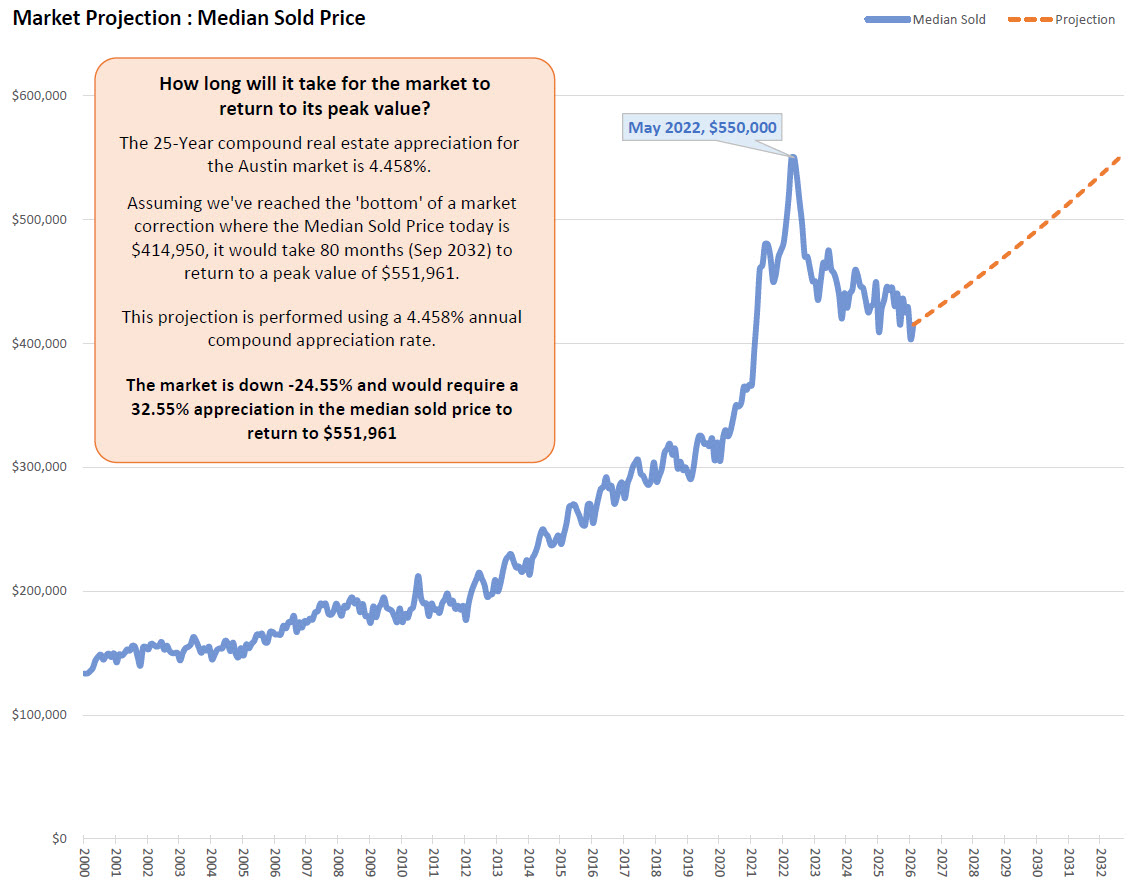
The Austin real estate market hit its all-time high in May 2022, when the median sold price reached $550,000. Fast-forward to February 2026, and that number has dropped to $414,950 — a decline of 24.55% from the peak. For buyers, sellers, and investors tracking austin home prices and austin real estate trends, the central question is no longer just "how far did we fall?" but "how long will it take to climb back?" Based on 25 years of compound market appreciation data, the answer points to September 2032 — roughly 80 months from today.
Where Austin Real Estate Stands Today
The austin housing market has been in a measurable correction since its pandemic-era peak. In May 2022, the median sold price for Austin properties reached $550,000, fueled by record-low interest rates, remote work migration, and intense buyer competition. Since then, the austin property market has experienced a significant pullback. As of February 2026, the median sold price sits at $414,950 — down $135,050 from peak, representing a 24.55% decline.
To put that in perspective, the market would need to appreciate 32.55% from today's price just to return to its May 2022 high of $551,961. That is not a small climb. But context matters here — Austin has a long track record of strong appreciation, and the market's historical performance gives analysts a reliable baseline for projecting what comes next.
The 25-Year Appreciation Rate: A Foundation for Austin Real Estate Forecasting
One of the most reliable tools in any austin real estate report is the long-term compound annual appreciation rate. For Austin, that figure stands at 4.458% per year, measured over a 25-year period. This rate captures the market's full cycle history — including the dot-com bust, the 2008 financial crisis, and the post-pandemic correction — making it a grounded and credible foundation for projection.
Using this 4.458% compound annual growth rate and starting from the current median sold price of $414,950, the austin real estate forecast places the market's return to peak value in September 2032. That is 80 months from the February 2026 baseline — nearly seven years. This timeline assumes the market has already found its bottom and that appreciation resumes from today's price level in a relatively steady, compounding fashion.
The Critical Assumption: Have We Reached the Bottom?
The September 2032 projection carries one important caveat: it assumes February 2026 represents the market bottom. That is not a guarantee. The austin housing market could experience further pullback before a recovery takes hold. Real estate markets rarely move in a straight line. The national and local economic environment — including employment levels, population inflows, and new housing supply — will all influence whether the current price level holds or dips further.
If the bottom has not yet been reached and prices decline further before recovering, the timeline to return to peak extends beyond 2032. Conversely, if external catalysts — such as a meaningful drop in interest rates or a surge in tech sector employment — reignite buyer demand ahead of schedule, appreciation could outpace the 4.458% historical rate in the early years of recovery, compressing the timeline. Neither outcome can be ruled out, and responsible austin real estate analysis requires acknowledging both.
Interest Rates and Affordability: The Weight on Recovery
One of the most significant headwinds facing the austin housing market in 2026 is the interest rate environment. Mortgage rates remain historically elevated compared to the 2020–2022 period, when rates near 3% were a primary driver of the price surge. Today's rates, hovering in the 6% to 7% range, translate into substantially higher monthly principal, interest, taxes, and insurance (PITI) payments for buyers of the median Austin home.
Even though the austin market has seen home prices fall significantly from the 2022 peak, the higher cost of financing means that the total monthly payment for the median property remains elevated by historical standards. This is a meaningful distinction in any austin real estate market update: a lower purchase price does not automatically translate to an affordable payment when borrowing costs are this high. The PITI burden continues to suppress demand, particularly among first-time buyers who lack equity from a previous home sale.
One Bright Spot: Price-to-Income Ratio Has Normalized
Despite the elevated PITI environment, there is a notable positive signal in current austin real estate trends: the median sold price to income ratio has returned to normal levels. During the peak of the market in 2021 and 2022, Austin home prices dramatically outpaced local incomes, creating one of the most severe affordability gaps in the city's modern history. That imbalance has since corrected.
The return to a normalized price-to-income ratio signals that the underlying relationship between what Austin residents earn and what homes cost has rebalanced. This is a foundational indicator of long-term market health. It suggests that if and when interest rates moderate, purchasing demand could reactivate relatively quickly — because the price level itself is no longer wildly disconnected from income levels. This dynamic is one of the more encouraging data points in the current austin housing market update.
What History Tells Us About Austin Real Estate Recovery Cycles
The Austin market has navigated corrections before. After the 2008 housing crisis, Austin recovered faster than most major U.S. metros, driven by diversified job growth in technology, healthcare, and government sectors. The 25-year compound appreciation rate of 4.458% that underpins the current projection is a product of those recovery cycles — it accounts for slowdowns and bouncebacks alike.
What makes the current correction unique is its origin. The 2022 peak was extraordinary — prices rose at a pace that far exceeded income growth, population fundamentals, or historical appreciation norms. The correction that followed has been a recalibration rather than a collapse. The austin property market did not experience the kind of foreclosure surge or inventory shock that characterized 2008. Supply and demand fundamentals, while softer than during the pandemic boom, have not broken down entirely. That context supports a recovery trajectory rooted in steady appreciation rather than a sharp V-shaped rebound.
What This Means for Buyers, Sellers, and Investors
For buyers entering the austin real estate market in early 2026, the data presents a mixed but informative picture. Prices are 24.55% below their peak, and the price-to-income ratio has normalized — both of which favor the buyer. However, elevated financing costs mean the all-in monthly payment still requires careful budgeting. Buyers who can commit to a long hold period stand to benefit from the projected appreciation path back toward peak values, with the historical model suggesting full recovery by September 2032.
For sellers, timing expectations against the 80-month recovery projection is essential. Those with equity built before 2019 are generally in a stable position. Sellers who purchased near the 2021–2022 peak, however, may face the reality that recouping their purchase price could require holding the property well into the early 2030s — assuming the 4.458% appreciation rate holds. For investors, the normalized price-to-income ratio and the long-term appreciation track record present an opportunity, but patience and rate sensitivity will be defining factors in any austin housing market strategy.
The Bottom Line on Austin's Path to Recovery
The austin real estate market is in a defined post-peak correction phase. From a high of $550,000 in May 2022 to $414,950 in February 2026, prices are down 24.55% and need to appreciate 32.55% to return to peak levels. Using 25 years of compound appreciation history at 4.458% annually, that return is projected for September 2032 — roughly 80 months away. That projection assumes today is the bottom, which remains an open question given elevated interest rates and persistently high PITI costs.
The positive signals — a normalized price-to-income ratio, a resilient local economy, and a strong long-term appreciation history — provide a credible foundation for eventual recovery. But real markets don't move on a straight line. Whether the bottom holds or softens further, whether rates ease or remain elevated, and whether Austin's economic engine continues to attract residents will all shape how the austin housing market actually unfolds between now and 2032. What the data makes clear is this: the path back to peak is measurable, grounded, and likely — but it requires time.
Frequently Asked Questions: Austin Real Estate Market 2026
1. Will Austin home prices continue to drop in 2026?
Based on current data, austin home prices are at $414,950 as of February 2026, down 24.55% from the May 2022 peak. Whether prices decline further depends largely on the interest rate environment, employment trends, and housing inventory levels. While the price-to-income ratio has returned to normal — a stabilizing signal — elevated mortgage rates continue to weigh on buyer demand and may exert downward pressure on pricing. The austin real estate market has not yet confirmed a definitive bottom, and further softening remains possible before a sustained recovery begins.
2. How long will it take for Austin real estate to recover to its peak value?
Using Austin's 25-year compound annual appreciation rate of 4.458%, and assuming the current median sold price of $414,950 represents the market bottom, the austin real estate forecast projects a return to the May 2022 peak of $551,961 in September 2032 — approximately 80 months from February 2026. This is a compound, not linear, projection, meaning the absolute dollar gains will be larger in later years. If the market has not yet bottomed or if the appreciation rate underperforms history, the recovery timeline extends further.
3. Is now a good time to buy a home in Austin, TX?
The austin housing market currently presents a nuanced opportunity for buyers. Home prices are significantly below their 2022 peak, and the median sold price to income ratio has normalized — both favorable indicators. However, mortgage rates remain elevated compared to the 2020–2022 period, which keeps monthly PITI payments high despite lower purchase prices. Buyers with long time horizons (7+ years), stable income, and the ability to absorb current financing costs are better positioned to benefit from the projected recovery. Those sensitive to monthly payment levels may benefit from waiting for rate relief before entering the market.
4. Why did Austin home prices drop so much after 2022?
The austin real estate market peaked in May 2022 as the result of an extraordinary confluence of factors: record-low mortgage rates, pandemic-era migration into Austin from higher-cost metros, limited housing inventory, and intense buyer competition. When the Federal Reserve began aggressively raising interest rates starting in 2022, demand collapsed rapidly and the affordability equation inverted. The median sold price fell from $550,000 to $414,950 — a 24.55% decline — as buyers either pulled back or lost purchasing power due to higher financing costs. The correction has been a market normalization, not a structural collapse.
5. What is the long-term appreciation rate for Austin real estate?
The 25-year compound annual appreciation rate for the austin property market is 4.458%. This figure is calculated across a full market cycle that includes multiple recessions, rate environments, and boom-and-bust periods, making it one of the most reliable benchmarks available for long-term austin real estate forecasting. It outpaces national inflation averages over similar periods and reflects Austin's sustained population growth, economic diversification, and enduring desirability as a place to live and work. This rate forms the basis for projections used in Team Price Real Estate's market cycle analysis.