NAR Pending Home Sales Hit Record Low in February 2026 — But Austin Is Bucking the Trend
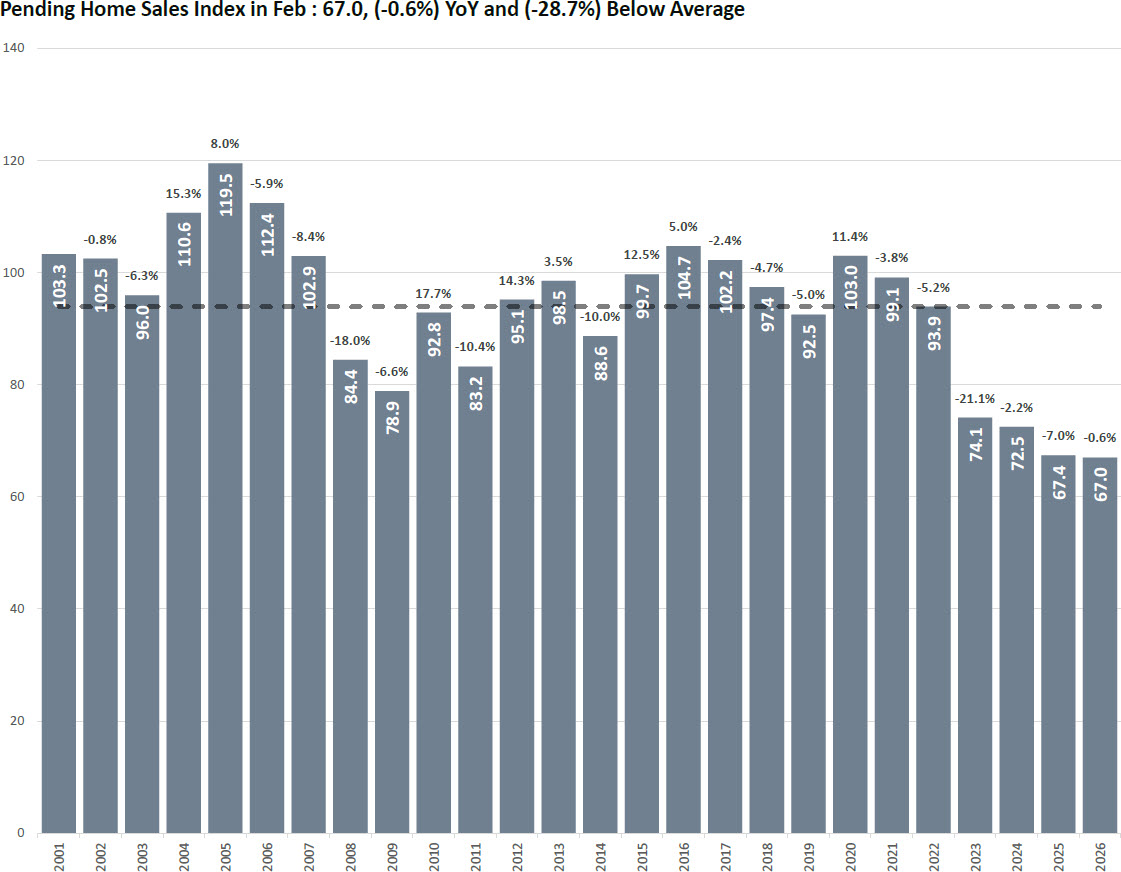
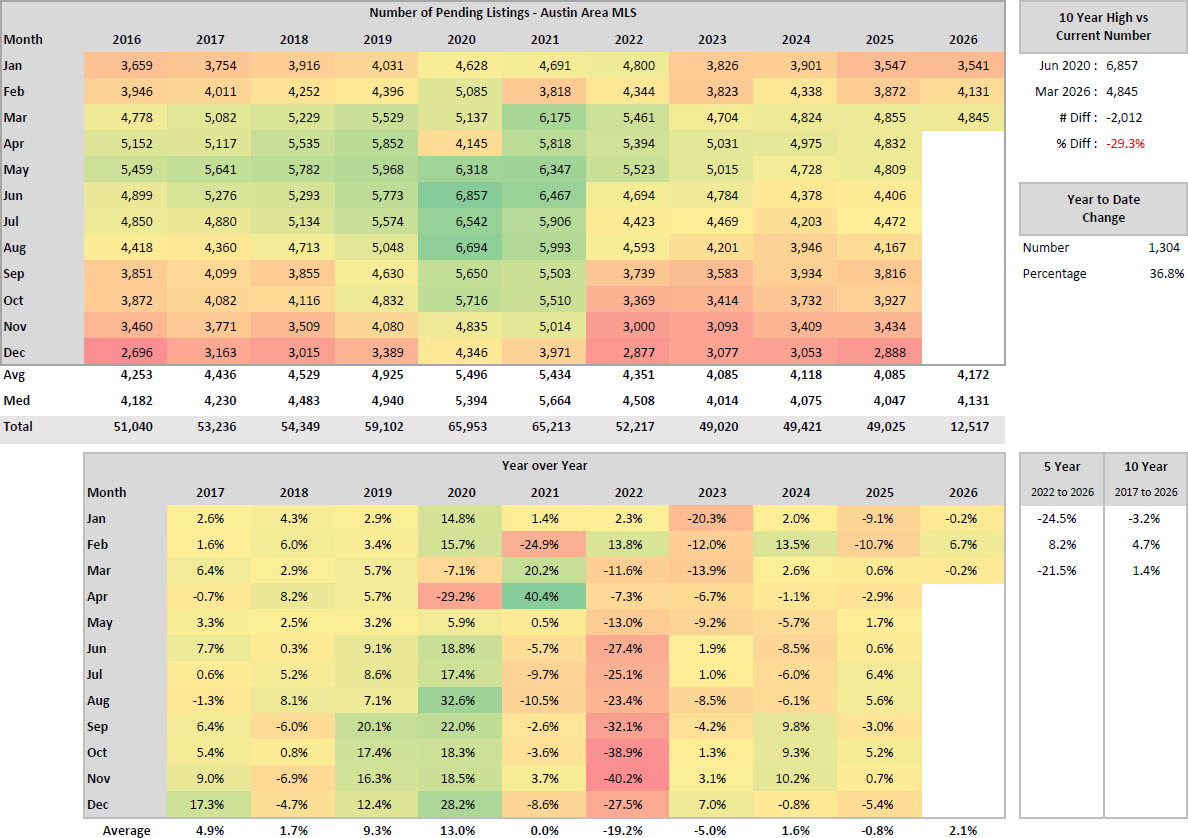
While the national housing market just recorded its weakest February demand since tracking began, Austin is telling a different story. The National Association of Realtors Pending Home Sales Index posted a reading of 67.0 in February 2026 — the lowest February figure recorded since NAR began publishing the index in 2001 and sitting 28.7% below the historical average of 100. Yet in the Austin Area MLS, pending home sales came in at 4,131 for February 2026, a 6.69% increase over February 2025's count of 3,872. At a moment when national buyer demand is at a historic low, the Austin real estate market is producing one of its more encouraging year-over-year readings in recent memory.
What the NAR Index Is Telling Us Nationally
The NAR Pending Home Sales Index measures signed contracts on existing homes, making it one of the most reliable forward-looking indicators of housing demand. A reading of 100 represents the average level of contract activity recorded in 2001, the index's baseline year. At 67.0, February 2026 lands not just below average — it lands below every other February in the index's 25-year history. For context, even during the housing crisis years of 2008 and 2009, February readings came in at 84.4 and 78.9 respectively. The February 2026 national reading of 67.0 is a full 10 points below those post-crisis lows. Elevated mortgage rates, persistent affordability challenges, and cautious buyer sentiment have continued to suppress contract activity across the country, and February's data makes clear that no meaningful national recovery in demand has taken hold.
The year-over-year change at the national level was -0.6% in February 2026, essentially flat but still negative. That marginal decline continues a pattern of persistent weakness that has characterized national pending sales since the rate-driven contraction of 2022. The national index has now spent three consecutive years operating well below its long-run average, and February 2026 offers no indication that a breakout is imminent.
Austin Is Moving in the Opposite Direction
Against that national backdrop, the Austin area housing market posted a February 2026 pending sales count of 4,131 — up 6.69% from 4,131 from 3,872 in February 2025. That is a meaningful positive swing, particularly given where Austin has been over the past several years. February 2024 saw pending listings at 4,338, and February 2023 came in at 3,823, so the current reading of 4,131 reflects a market that is recovering volume after a prolonged post-pandemic correction. Austin real estate trends are showing renewed buyer engagement at the contract stage, which is the earliest measurable signal of demand returning to the market.
It is worth noting the broader historical context for Austin pending sales. The 10-year high for any single month in the Austin Area MLS was 6,857 in June 2020, a pandemic-era surge fueled by record-low mortgage rates and an extraordinary influx of relocating buyers. February 2026's count of 4,131 is still well below that peak, but the directional shift is what matters most right now. After years of year-over-year declines — including a sharp -10.7% drop in February 2025 and a -12.0% decline in February 2022 — a +6.69% YoY gain in February 2026 represents a genuine reversal in Austin housing trends.
Why Austin Is Outperforming the Nation
Several structural factors help explain why the Austin property market is producing positive pending sales momentum while the national index hits historic lows. Austin remains one of the most economically dynamic metros in the country, with a diversified technology and professional services employment base that continues to attract relocating workers and households. While the speculative frenzy of 2020 and 2021 has long since unwound, the underlying demand drivers for Austin housing — population growth, job creation, and relative affordability compared to coastal markets — remain intact.
Additionally, Austin's price correction following the 2022 peak has reset expectations in a way that is now drawing buyers back into the market. Sellers who repriced aggressively have created purchase opportunities that were not available during the peak years, and buyers who were priced out or sitting on the sidelines are beginning to re-engage. The February 2026 pending sales data suggests that this re-engagement is translating into signed contracts, which is ultimately what drives closed sales one to two months forward.
What This Means for Buyers and Sellers
For buyers in the Austin real estate market, February's pending sales increase is a signal that competition is beginning to return to certain price points and submarkets. This is not the frenzied market of 2021, but buyers who have been waiting for signs of stability may find that the window for relatively low competition is narrowing. Acting with preparation and pre-approval in place is increasingly important as demand edges upward.
For sellers, the February 2026 data offers measured encouragement. A 6.69% year-over-year increase in pending contracts means more buyers are actively writing offers in Austin than they were a year ago. However, sellers should remain realistic about pricing — the market is recovering, not surging, and properties that are priced in line with current comparable sales are the ones generating contract activity. Overpriced listings will continue to sit while correctly priced homes benefit from the uptick in buyer engagement.
The contrast between a nationally historic low in pending home sales and Austin's year-over-year gain is one of the clearest data points yet that the Austin housing market is operating on its own recovery trajectory. The national headwinds are real, but Austin's local fundamentals are proving resilient enough to produce genuine demand momentum even in a difficult rate environment.
Frequently Asked Questions
What is the NAR Pending Home Sales Index and why does it matter?
The NAR Pending Home Sales Index is a monthly measure of signed real estate contracts on existing homes across the United States. Because it captures the contract stage rather than the closing stage, it functions as a leading indicator of closed sales activity typically one to two months into the future. A reading of 100 equals the average level of activity recorded in 2001, the index's baseline year. When the index falls well below 100, as it did in February 2026 with a reading of 67.0, it signals that national housing demand is significantly below historical norms — making it a critical data point for understanding austin real estate trends and broader market direction.
Why are Austin pending home sales rising when the national market is at a historic low?
Austin's local housing market is driven by a distinct set of fundamentals that differ from national averages. The metro's technology-focused employment base, continued in-migration, and a meaningful price correction from the 2021–2022 peak have combined to create renewed buyer interest at the contract stage. While elevated mortgage rates are suppressing demand nationally, Austin buyers appear to be adjusting to the rate environment and re-engaging with the market, producing the 6.69% year-over-year gain recorded in February 2026 Austin area pending data.
What does a pending home sale mean in the Austin real estate market?
A pending home sale in the Austin Area MLS represents a property that has a signed purchase contract but has not yet closed. It is one of the most reliable real-time indicators of buyer demand because it reflects current decision-making rather than activity that occurred 30 to 60 days prior. Tracking monthly pending counts and their year-over-year changes — as the Austin Area MLS data allows — gives buyers, sellers, and agents an early read on whether the austin housing market is accelerating, decelerating, or stabilizing.
How does February 2026 Austin pending sales compare to recent years?
February 2026 Austin area pending listings came in at 4,131, which is above February 2025's count of 3,872 by 6.69% and above February 2023's count of 3,823. It remains below February 2024's count of 4,338 and well below the pandemic-era highs, but the year-over-year positive swing is the most meaningful improvement Austin has recorded in this metric in several years. The trend suggests the austin housing market update for early 2026 is one of gradual demand recovery rather than stagnation.
Is now a good time to buy a home in Austin given current pending sales data?
Pending sales data alone does not determine whether it is a good time to buy — individual financial circumstances, mortgage qualification, and specific property goals all play a role. However, the February 2026 data does indicate that buyer competition in Austin is increasing on a year-over-year basis, which suggests that those waiting for the lowest-competition environment may be past the optimal window. Austin real estate market conditions in early 2026 reflect a market in early recovery, where buyers still have more negotiating leverage than they did during the 2021 peak but less than they had at the trough of 2023.