Austin Housing Market: The Correction Has Begun — But It May Not Be Over Yet
Published | Posted by Dan Price
Austin Housing Market: The Correction Has Begun — But It May Not Be Over Yet
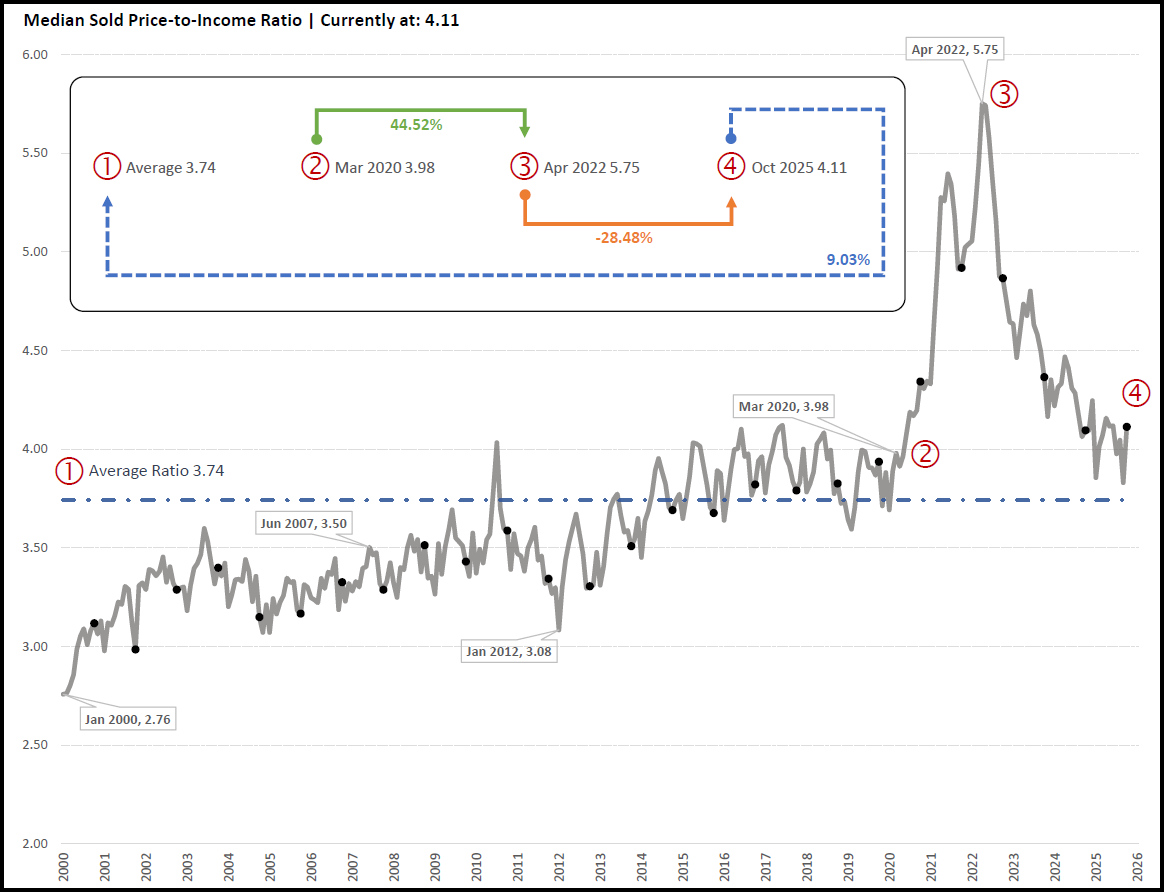
Austin’s housing market has moved decisively off its 2022 highs, yet the numbers make one thing clear: the rebalancing isn’t finished. As of October 2025, the median sold price-to-income ratio sits at 4.11 — well below the April 2022 peak of 5.75, but still elevated compared to the 25-year average of 3.74. That’s a 28.5% decline from the top, but the market remains about 9% overvalued by historical standards. The correction phase is well underway, but given how affordability cycles work, Austin may not stop at balance — it could overcorrect before stabilizing.
From March 2020 to April 2022, Austin’s price-to-income ratio surged from 3.98 to 5.75, marking a 44.5% affordability deterioration in just two years. This was driven by an extraordinary mix of ultra-low interest rates, remote work relocation, and speculative capital inflows that inflated home values faster than local incomes could follow. Those tailwinds have since reversed. As mortgage rates normalized, investor demand cooled, and active inventory rose, Austin began its multi-year correction cycle — a process that typically takes several years to fully resolve.
Even after a substantial pullback, Austin’s housing market still trades above its long-term affordability baseline. A price-to-income ratio of 4.11 means the typical household still needs more income than historical norms to afford a median-priced home. For that ratio to fall back to the 25-year average of 3.74, either incomes must rise or prices must fall. Given the current economic climate, the income side of that equation is unlikely to contribute much relief.
Austin’s local economy remains anchored by technology and professional services, both of which are undergoing major transitions. The rapid adoption of artificial intelligence has begun to change staffing structures, with many companies consolidating positions, slowing hiring, and automating previously high-paying roles. Wage growth has flattened as a result, and most compensation adjustments now reflect inflation catch-up rather than productivity gains. In short, income growth has lost momentum. With earnings growth subdued, the only other variable capable of restoring affordability is price correction.
If incomes remain relatively flat and the market simply returns to its 25-year average ratio of 3.74, that would imply roughly a 9% decline in median home prices from today’s levels. That’s not a collapse, but rather a normalization to long-term equilibrium — where home values align more closely with what local households can sustainably afford. However, real estate markets rarely stop neatly at equilibrium. They often overshoot before finding their footing.
The last time Austin experienced an affordability overcorrection was in January 2012, when the ratio bottomed at 3.08 after the Great Recession. That level represented a significant undervaluation relative to income. If a similar pattern were to repeat, moving from 4.11 to 3.08 would require a 25% reduction in the price-to-income ratio — effectively a 25% decline in median home prices if incomes remain constant. While such a decline may sound dramatic, it wouldn’t be unprecedented. Historically, markets that rise rapidly and well above long-term norms tend to swing equally far in the other direction before stabilizing.
The underlying pressure point is no longer mortgage rates, which have already priced into the market. The challenge is income stagnation. Austin’s affordability problem is now primarily an earnings problem — particularly in a tech-heavy economy that’s slowing its wage growth. Incomes that once rose faster than home prices during the 2010s are now flatlining just as inventory expands. The city’s economic engine is still healthy, but not accelerating. Without higher incomes, the only way affordability can improve is through continued price adjustment.
This dynamic sets the stage for a slow, grinding return to balance. Austin’s housing market has already deflated from its speculative peak, but the correction phase likely has another leg to run. If affordability trends follow historical precedent, the market will continue drifting toward the long-term ratio of 3.74 — or potentially dip below it into the low 3s before rebounding. These moves rarely happen in straight lines; rather, they unfold gradually as sellers adjust expectations, buyers regain leverage, and new supply competes for demand.
Importantly, this doesn’t signal distress. It signals normalization. Price corrections are a necessary part of long-term market health. Austin’s growth fundamentals — population inflow, employment diversity, and lifestyle demand — remain strong. The current shift simply represents the process of recalibrating prices to match today’s economic capacity. The pandemic boom created a pricing disconnect; the years ahead are about restoring affordability to a sustainable level.
If the market reverts to its long-term average, expect moderate price declines of roughly 8–10%. If it overcorrects like in 2012, the adjustment could reach 20–25%. Either way, the data points to a continuing normalization — a slow rebalancing that ensures long-term stability and healthier fundamentals. For buyers, this environment provides leverage and opportunity. For sellers, it underscores the need for realistic pricing. The correction has begun, but the rebalancing story still has a few chapters left to write.
FAQ
1. Is the Austin housing market still overpriced after the correction?
Yes. Even after nearly a 30% improvement in affordability since 2022, the Austin housing market remains roughly 9% above its long-term average price-to-income ratio. At 4.11, the current ratio suggests that home prices still exceed what local incomes can comfortably sustain. In other words, affordability has improved but not yet returned to equilibrium. Historically, Austin’s housing cycles have not plateaued at overvaluation; they tend to correct fully back to the average — and often a bit beyond — before stabilizing.
2. Could Austin home prices fall further in 2026?
It’s possible, and even probable, if income growth remains stagnant. To reach the historical affordability ratio of 3.74, prices would need to decline approximately 9% from current levels. If the market overcorrects — which is common following periods of extreme price growth — the ratio could slide toward 3.0, implying a 20–25% reduction in home values. The magnitude and pace of decline will depend on how local employment and consumer confidence evolve, but the trajectory points to continued gradual correction rather than renewed expansion.
3. Why aren’t rising incomes balancing out Austin’s home prices?
Austin’s economic story has shifted. For years, tech growth and migration pushed incomes higher, offsetting rising home prices. But as companies across the tech and professional sectors embrace AI and automation, hiring has slowed, and wage growth has decelerated sharply. Many high-paying roles are being consolidated or replaced with lower-cost efficiency solutions. As a result, Austin’s income growth has stalled just as housing costs remain historically high. With limited income expansion, affordability improvements can only occur through lower housing prices — not through wage gains.
4. What happens if the market overcorrects again, like it did in 2012?
If Austin follows its historical pattern and affordability drops below the long-term average, it would represent a temporary but healthy reset. In 2012, the city’s price-to-income ratio fell to 3.08, creating a period of undervaluation that fueled a decade of sustainable growth afterward. An overcorrection today could set up a similar scenario, paving the way for stronger long-term affordability and future appreciation. While it may feel uncomfortable in the short term, it would lay the foundation for a more balanced and stable housing market over the next cycle.
5. What should buyers and sellers expect in the months ahead?
Buyers should expect improved leverage, a wider range of inventory, and sellers more open to negotiation as the market normalizes. For sellers, success will depend on accurate pricing and property condition rather than relying on scarcity-driven demand. This phase of the cycle rewards realistic expectations and data-informed decisions. The next several quarters will likely bring continued softening, but also greater long-term opportunity as the market resets around more sustainable fundamentals.