Austin Housing Affordability Is Resetting: What the February Price-to-Income Data Reveals About the Austin Real Estate Market
After one of the most extreme affordability expansions in modern history, the Austin housing market is now firmly in a normalization cycle.
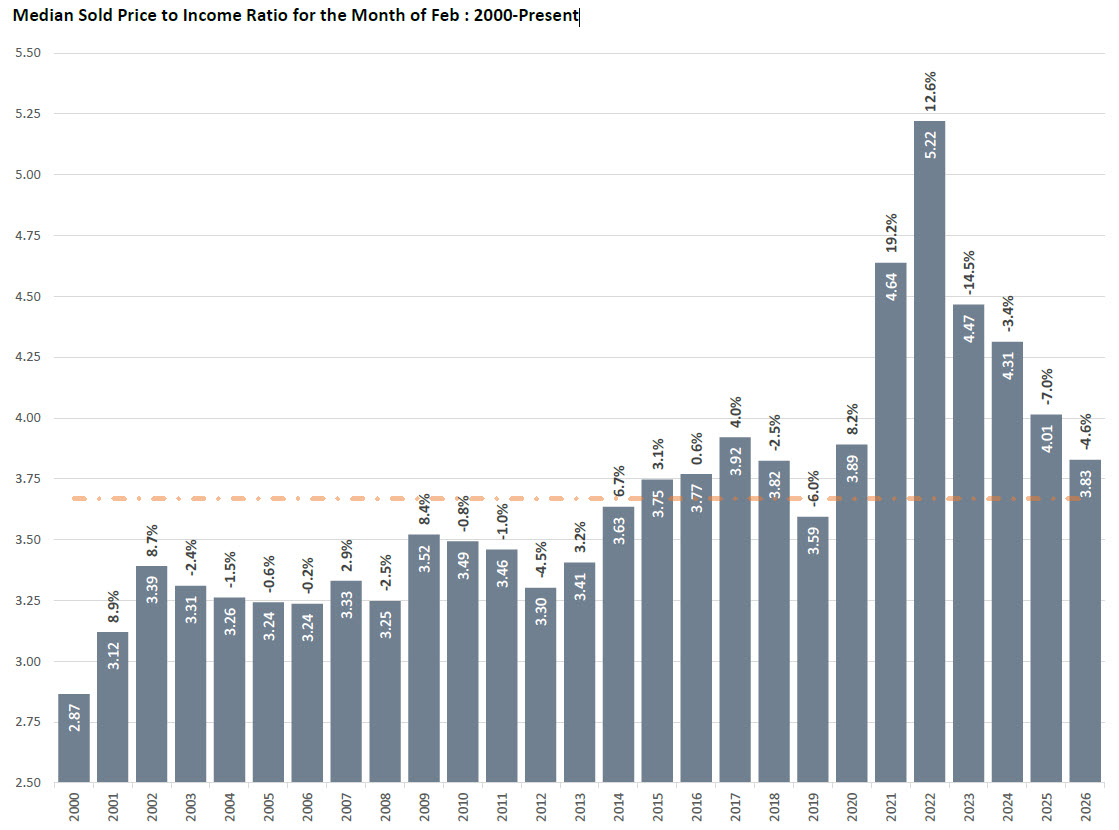
The latest February data on the median sold price to income ratio from 2000 through 2026 provides one of the clearest long-cycle indicators available in the Austin real estate market. This ratio measures how many times median household income is required to purchase the median-priced home. It is one of the most important structural gauges of affordability and long-term sustainability in the Austin property market. When this ratio stretches too far above historical norms, it signals imbalance. When it compresses back toward long-term averages, it signals stabilization.
From 2000 through roughly 2012, Austin home prices remained tightly aligned with income growth. During that period, the February median sold price to income ratio generally ranged between 3.1 and 3.5. That was the historical affordability band that defined equilibrium in the Austin housing market. Buyers could purchase homes at roughly three to three and a half times their annual household income. This was not a boom phase. It was structural balance.
Beginning around 2013, the Austin real estate market entered a higher affordability regime. The ratio climbed into the upper 3s and occasionally into the low 4s. Between 2014 and 2019, February readings ranged from 3.63 to 4.00. This expansion was supported by strong population growth, technology job creation, and historically low mortgage rates. Even at 4.00 in 2017 and 3.82 in 2018, the Austin housing trends were elevated but still within a range that could be supported by income and financing conditions.
The structural break occurred during the pandemic-driven housing surge. In February 2021, the ratio jumped to 4.64. In February 2022, it peaked at 5.22. That level represented an unprecedented expansion in Austin home prices relative to local income. At 5.22 times income, affordability had stretched well beyond the historical band that defined the Austin market for more than two decades. Ultra-low mortgage rates temporarily masked the strain, but the underlying math became unsustainable once rates normalized.
Since that 2022 peak, the Austin real estate market has been in a measurable affordability repair cycle. The February ratio fell to 4.47 in 2023, then to 4.31 in 2024, then to 4.01 in 2025, and now stands at 3.83 in February 2026. From the 5.22 peak to 3.83 today, the ratio has compressed by approximately 26.6 percent. That is a significant rebalancing in the Austin housing market update.
This compression tells us two important things about current Austin real estate trends. First, the extreme excess of the pandemic surge has largely been removed from the system. Second, the market is moving closer to its long-term affordability anchor, but it has not fully returned to equilibrium.
The long-term February average appears to sit near 3.66. At 3.83, Austin home prices relative to income remain modestly elevated compared to the 2000–2019 norm. This suggests that affordability has improved substantially, yet some structural normalization may still be ahead. Whether that adjustment occurs through flat pricing combined with income growth, or through additional modest price softening, will define the next phase of the Austin real estate forecast.
It is important to understand that this ratio does not move randomly. It reflects the interaction between three forces: price appreciation, wage growth, and mortgage rate conditions. During 2020 through 2022, price appreciation dramatically outpaced income growth, forcing the ratio upward. Since mid-2022, a combination of slower price growth and continued income expansion has pushed the ratio downward. This is not a crash dynamic. It is a reversion-to-mean process.
For buyers in the Austin property market, this data shows that purchasing power has improved materially compared to the 2022 peak. While mortgage rates remain higher than pandemic lows, the affordability burden tied to inflated price multiples has eased. The Austin housing trends now reflect a market that is operating closer to long-term structural norms rather than speculative extremes.
For sellers, this data reinforces the importance of pricing discipline. The Austin real estate market is no longer functioning at five times income multiples. Buyers are operating within tighter financial constraints. Listings priced as if the 2021–2022 environment still exists are more likely to experience extended days on market and eventual price adjustments. The Austin market today is grounded in affordability math, not acceleration psychology.
For investors, the February price-to-income ratio provides critical context for long-term positioning. Markets that revert toward historical affordability bands often enter a stabilization phase characterized by slower but more sustainable growth. The compression from 5.22 to 3.83 suggests that much of the affordability distortion has already corrected. Historically, when Austin home prices trade between 3.5 and 3.8 times income, long-term risk-adjusted entry points improve relative to periods when ratios exceed 4.5 or 5.0.
From a broader economic perspective, this affordability repair strengthens the long-term foundation of the Austin housing market. Extreme ratios tend to suppress transaction volume because buyers become locked out. As the ratio compresses, more households regain eligibility, supporting healthier turnover and inventory absorption.
The key question for the Austin real estate forecast is whether the ratio stabilizes near 3.7 to 3.8 or continues compressing below 3.6. If income growth continues at a moderate pace and Austin home prices remain relatively flat, normalization could occur without significant additional price declines. If wage growth slows while financing conditions remain tight, further modest price adjustment may be required to complete the cycle.
What is clear from the February 2000–2026 data is that the Austin real estate market has moved out of its distortion phase and into its normalization phase. The affordability extremes of 2021 and 2022 are no longer present. The market is operating within a range that historically aligns more closely with sustainable long-term performance.
The Austin housing market update for February confirms a structural shift back toward equilibrium. This is not a collapse narrative. It is a recalibration story driven by mathematics, income alignment, and long-cycle mean reversion. The Austin property market is stabilizing on firmer ground than it was during the peak surge years, and that stability forms the foundation for the next phase of Austin real estate trends.
Frequently Asked Questions
Why are Austin home prices adjusting downward from their 2022 peak?
Austin home prices expanded rapidly during 2020 through 2022 due to low mortgage rates and accelerated migration. When rates rose, monthly payments increased significantly, reducing buyer purchasing power. As a result, the price-to-income ratio peaked at 5.22 in February 2022 and has since compressed to 3.83. This adjustment reflects a return toward long-term affordability norms within the Austin real estate market.
Is the Austin housing market crashing?
The February price-to-income data does not indicate a crash dynamic. Instead, it shows a normalization process. The ratio has declined 26.6 percent from peak levels, bringing Austin housing back toward its historical band near 3.6 to 3.7. This suggests recalibration rather than systemic distress in the Austin property market.
What is a healthy price-to-income ratio for Austin real estate?
Historically, from 2000 through 2019, February ratios ranged between approximately 3.1 and 3.8, with a long-term average near 3.66. When Austin home prices exceed 4.5 times income, affordability stress increases. Ratios closer to the mid-3 range have historically aligned with sustainable growth in the Austin real estate market.
Will Austin home prices continue to decline?
Future movement depends on the relationship between income growth, mortgage rates, and listing prices. If incomes continue rising and prices stabilize, the ratio may normalize without significant additional declines. If wage growth slows, modest further price adjustments may occur as part of the Austin real estate forecast.
How does affordability affect the Austin real estate market long term?
Affordability directly impacts transaction volume, buyer eligibility, and long-term price stability. When ratios stretch above historical norms, activity often slows because fewer households qualify. As the Austin housing market returns to equilibrium levels, turnover and sustainable demand typically improve, strengthening the foundation of the Austin property market.