Austin Real Estate : Inventory Surges While Demand Slips
Published | Posted by Dan Price
Austin Housing Market Update: Inventory Surges While Buyer Activity Softens
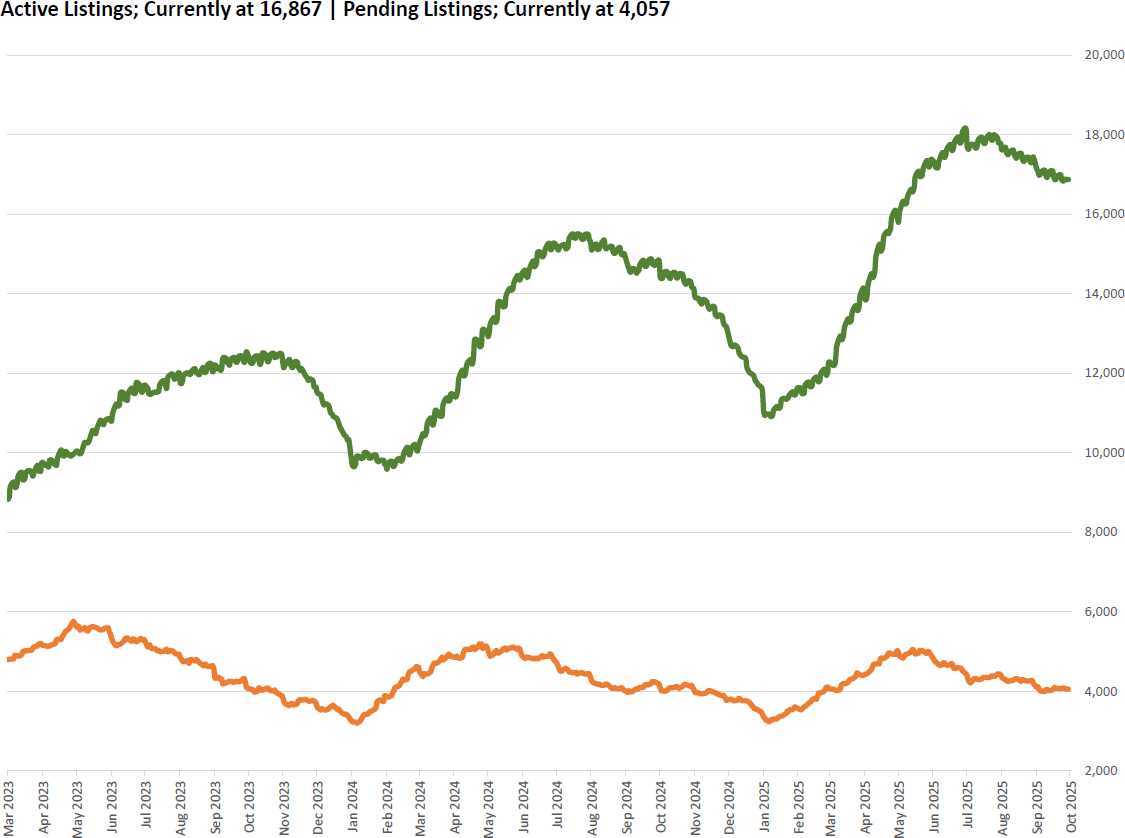
The Austin real estate market is showing a clear divergence between rising inventory and relatively steady but slowly declining buyer activity. Active listings have nearly doubled over the past three years, while pending sales have slipped only modestly. This imbalance explains why prices remain under pressure and why the months of inventory ratio has reached some of its highest levels in over a decade.
The data is straightforward. In January 2023, active listings hovered around 9,100, while pendings stood near 4,200. By mid-2025, actives swelled to more than 18,000 — a nearly 100 percent increase. Pendings, however, only shifted from the low 4,000s to a range that briefly touched 5,700 before falling back to about 4,000 by late 2025. That means supply has raced ahead of demand, creating more competition among sellers and slower absorption across the Austin housing market.
Housing Prices and Market Pressure While today’s dataset focuses on inventory and contract activity, the implications for Austin home prices are clear. With active listings climbing far faster than pendings, sellers have been forced to adjust pricing strategies. This is consistent with the broader Austin real estate forecast, which continues to show that values remain well below the May 2022 peak. As inventory builds, even minor drops in demand create stronger downward pressure on Austin home prices.
The spread between actives and pendings is particularly telling. Historically, Austin housing trends have relied on balance: when pendings tracked closely with actives, prices were stable or rising. In today’s environment, that ratio has widened, signaling that the Austin property market is in a buyer-favored phase. This is why list-to-sale price ratios have softened and why price drops remain elevated across much of the metro area.
Regional and Seasonal Trends Pendings followed their normal seasonal rhythm in 2023 and 2024, peaking in spring and trailing off toward year-end. But the peaks themselves are lower than in past cycles, underscoring reduced buyer urgency. For example, April 2023 reached just above 5,700 pendings, compared with levels above 7,000 in pre-2022 years. By September 2025, pending sales fell back toward 4,000, highlighting weaker late-year demand.
Active listings, by contrast, did not simply fluctuate seasonally — they built steadily. In April 2023, actives sat near 10,000, rising past 15,000 by mid-2024 and topping 18,000 by June 2025. This surge shows how new supply, coupled with slower absorption, is reshaping the Austin real estate market.
Implications for Buyers, Sellers, and Investors For buyers, the Austin housing forecast continues to signal opportunity. More options, longer days on market, and frequent price adjustments create negotiating leverage that was impossible just three years ago. A buyer entering today’s market faces nearly double the selection compared with early 2023.
For sellers, the message is sharper. Simply listing a home is no longer enough; pricing strategy, presentation, and flexibility are critical. With pendings clustered around 4,000 despite elevated active inventory, sellers must recognize the competition and plan accordingly.
For investors, the Austin real estate report points to a market in transition. Higher inventory relative to pending contracts suggests that rent-to-price ratios and cap rate spreads may continue to improve, especially in submarkets where supply has run ahead of end-user demand. The Austin property market is no longer defined by scarcity but by differentiation — investors can secure deals if they focus on cash flow metrics instead of betting on rapid appreciation.
Long-Term Market Outlook The broader Austin real estate forecast indicates that recovery to peak values will take time. With actives pushing higher and pendings hovering near the low 4,000s, the Austin market update suggests at least several more years before equilibrium is restored. That means price stabilization, not appreciation, is the most realistic near-term outcome.
What stands out is the relative stability of pendings compared to the volatility of actives. Pending sales have ranged within about 1,700 contracts over nearly three years, while actives have swung by almost 10,000 listings. This highlights that the demand side is steady but not expanding, while supply continues to surge. For the Austin housing market, that imbalance is the central trend shaping pricing, negotiations, and future forecasts.
Frequently Asked Questions 1. What is driving the rise in active listings in Austin? Active listings have nearly doubled since early 2023, largely due to a combination of new construction deliveries, slower buyer absorption, and more sellers testing the market. This rise reflects supply outpacing demand, a key factor in current Austin housing trends.
2. Why haven’t pending sales fallen as sharply as active listings have risen? Pending sales have fluctuated within a narrower band, ranging between about 4,000 and 5,700 over three years. This shows that while buyer demand has softened, it has not collapsed. The relative steadiness in pendings highlights that Austin still attracts consistent buyers, even amid higher interest rates.
3. How does the current market affect Austin home prices? With actives rising faster than pendings, sellers are facing more competition. This imbalance has pressured prices downward and kept values well below the 2022 peak. Buyers now benefit from greater negotiating power and more favorable terms.
4. Is this a buyer’s market or a seller’s market in Austin right now? Given the widening gap between actives and pendings, Austin is operating in a buyer-leaning market. Buyers have more leverage, while sellers must adapt with sharper pricing and stronger property presentation.
5. What does the long-term Austin real estate forecast suggest? The Austin real estate forecast points to a slow recovery. With inventory still rising and pendings stable but not growing, it may take several years before pricing returns to prior peaks. For now, stabilization rather than rapid appreciation is the more likely outcome.