Austin Housing Market Update: February 2026 Sets a Record Low for Competitive Bidding
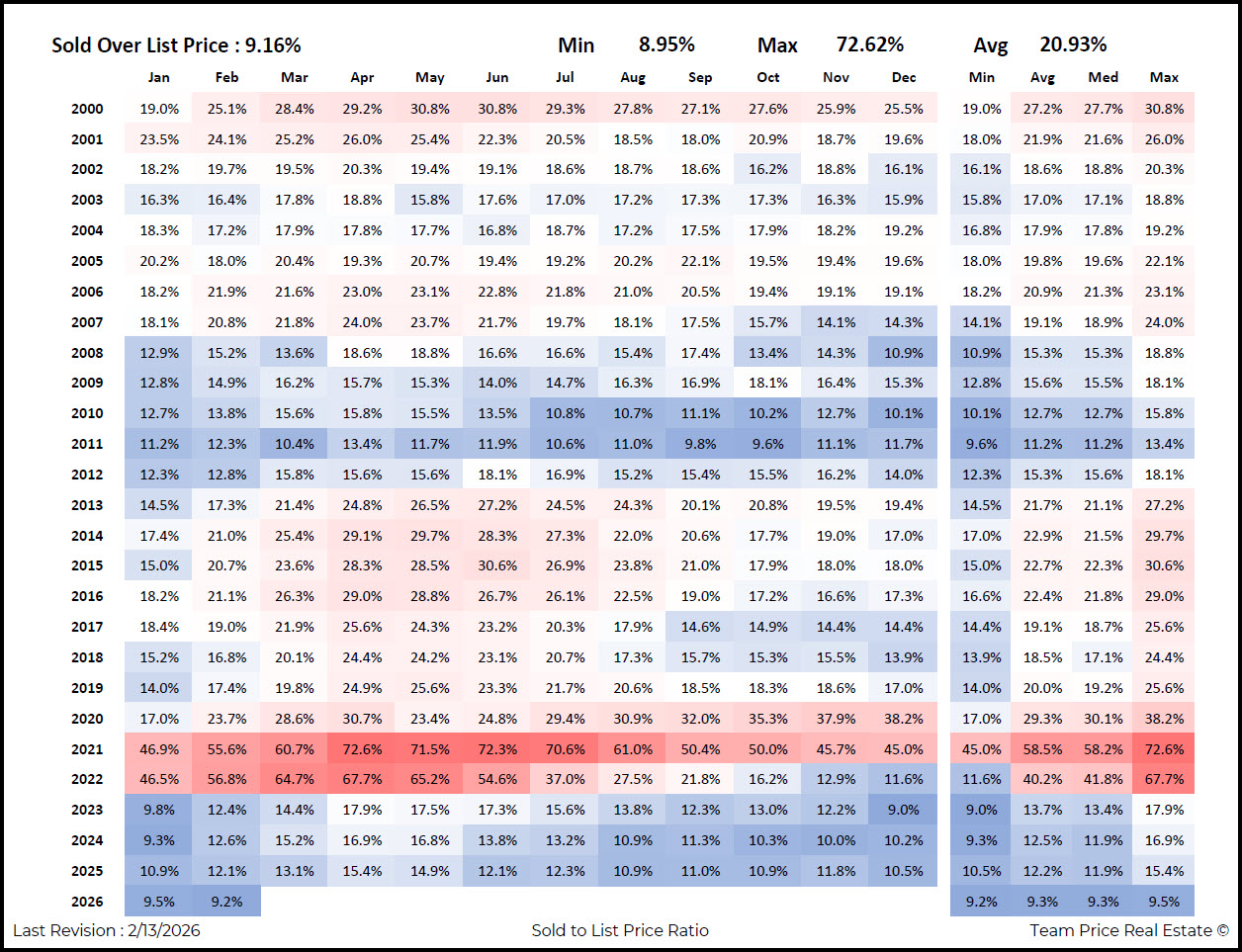
The Austin housing market is sending a clear signal in early 2026: competitive bidding has cooled to historically low levels, and the data confirms a major shift in the Austin real estate market. Through February 2026, just 9.16% of residential properties in the Austin-area sold over list price. That is the lowest February reading on record in this dataset, which tracks monthly performance back to 2000. The previous all-time monthly low occurred in December 2023 at 8.95%, and February 2026 is now operating within a fraction of that historic trough.
For context, the long-term average percentage of homes selling over list price across the full data series is 20.93%. That means today’s 9.16% reading is less than half of the long-run norm for the Austin real estate market. This is not a minor seasonal fluctuation. It represents a structural cooling in bidding intensity across the Austin property market.
A 25-Year View of Austin Real Estate Trends
To understand the magnitude of this shift in Austin housing trends, it helps to zoom out. From 2000 through 2019, February typically recorded between 15% and 25% of homes selling over list price in most years. Even during slower market cycles such as 2008 through 2012, February readings rarely dipped below the low teens. For example, February 2009 came in at 14.9%, February 2010 at 13.8%, and February 2011 at 12.3%.
Those years were considered softer market environments at the time. Today’s 9.16% is materially below those post-financial-crisis levels. The distortion years of 2020 through 2022 stand in stark contrast. February 2021 posted 55.6% of homes selling over list price. By March 2021, that number exploded to 60.7%, and the all-time monthly high reached 72.6% in April 2021. In 2022, February still printed 56.8%. That period marked the most aggressive seller leverage phase in modern Austin real estate history.
But markets normalize. And in this case, normalization has gone further than many expected.
In 2023, the annual average percentage of homes selling over list price fell to 13.7%. In 2024, it declined further to 12.5%. In 2025, it averaged 12.2%. Now, February 2026 has dropped to 9.16%, setting a new February record low and placing the Austin housing market near its lowest competitive reading in 25 years.
What This Means for Austin Home Prices
The percentage of homes selling over list price is one of the cleanest sentiment indicators in any Austin real estate report. It measures buyer urgency. It reflects leverage. It captures how much emotional intensity is present in the Austin market. When that figure is high, buyers compete. When it is low, buyers negotiate.
At 9.16%, roughly 91% of homes are not selling above their asking price. That tells us list price is no longer a launch point for bidding wars. It is closer to a ceiling. Sellers who misprice are not getting rescued by multiple offers. Instead, they are facing reductions. This does not automatically mean Austin home prices are collapsing. It does mean pricing discipline matters more than it has in years. The Austin real estate trends are pointing toward a negotiation-driven environment rather than an escalation-driven one.
The Austin real estate forecast in this context depends heavily on supply and financing conditions. If mortgage rates decline meaningfully, competitive pressure could return quickly. Historically, this metric responds fast when demand accelerates. But as of February 2026, the Austin housing market update shows subdued buyer aggression.
February Seasonality Matters
February is typically the early ramp-up month for the spring selling season in the Austin housing cycle. In stronger years, competitive pressure begins building in late winter and peaks in March through May. Yet February 2026 is not showing signs of a surge in over-list transactions. Instead, it is printing the weakest February reading on record. That suggests spring momentum is developing more slowly than historical norms.
For agents and brokers analyzing the Austin property market, this is important. If early spring does not show competitive acceleration, sellers entering the market in March and April must price with realism. The days of aspirational pricing followed by automatic bidding wars are behind us, at least for now.
Historical Context and Market Positioning
Across the full data set, the minimum monthly reading is 8.95%, the maximum is 72.62%, and the average is 20.93%. That range illustrates just how wide Austin market cycles can be. In 2021, the annual average was 58.5%. In 2022, it was 40.2%. In 2023, it dropped sharply to 13.7%. In 2024, it was 12.5%. In 2025, 12.2%. Now February 2026 is below 10%.
This is not simply cooling from an overheated peak. It is a complete rebalancing of leverage in the Austin real estate market. From a macro perspective, this aligns with broader shifts in affordability and financing. When borrowing costs are elevated, buyer sensitivity to price increases sharply. The Austin housing forecast must incorporate that reality. Buyers today analyze payment, not just price. That changes behavior.
What This Austin Real Estate Report Signals Going Forward
The Austin housing market update from this dataset points to three structural realities. First, leverage has shifted toward buyers. When over 90% of homes are not selling above list price, negotiation becomes the default expectation. Second, pricing strategy has become the primary performance driver. Homes priced correctly can still attract interest and potentially sell at or slightly above list. Homes priced above market are unlikely to be bid up in this environment.
Third, volatility remains possible. The same metric that collapsed from 58.5% in 2021 to 13.7% in 2023 could rebound if macro conditions improve. The Austin real estate forecast must remain data-driven and flexible. As of today, however, the Austin real estate trends show a disciplined, negotiation-heavy market operating at one of the lowest competitive levels in modern history.
FAQ: Austin Housing and Market Trends
Is the Austin real estate market slowing down in 2026?
The data shows that competitive bidding has slowed significantly. With only 9.16% of homes selling over list price in February 2026, buyer urgency is historically low compared to long-term averages. While this does not necessarily mean prices are collapsing, it does signal a shift toward a more balanced Austin housing market.
Are Austin home prices still rising?
This dataset measures over-list transactions, not direct price changes. However, when fewer homes sell above list price, it typically reflects reduced upward price pressure. Austin home prices may stabilize or adjust depending on inventory levels and financing conditions.
Why are fewer homes selling over list price in Austin?
Higher mortgage rates and increased buyer payment sensitivity reduce aggressive bidding behavior. The Austin property market is now more negotiation-driven, with buyers expecting concessions rather than competing above asking price.
What does this mean for sellers in the Austin real estate market?
Sellers must price accurately from day one. In a market where more than 90% of homes are not selling over list price, aspirational pricing can lead to longer days on market and eventual reductions.
Could competitive bidding return to the Austin housing market?
Yes. Historically, the percentage of homes selling over list price responds quickly to changes in financing and demand. If rates decline or buyer confidence improves, the Austin real estate trends could shift again. For now, however, the Austin housing market update indicates muted competitive pressure.