


• Sign Up
  • Log In
Team Price Real Estate
(512) 213-0213realestate@teamprice.com
  • Search
    • Search Properties
    • Featured Properties
    • Explore Local Guide
    • Browse Properties by Area
    • Browse Properties by City
    • Browse Properties by Zip
    • Browse Properties by Subdivision
    • Browse Properties by School District
  • Buying
    • Home Buyer's Guide
    • Real Estate Forms
    • Mortgage Calculator
    • First Time Home Buying
    • Assuming a FHA home loan
    • Assuming a VA Home Loan
  • Selling
    • Home Seller's Guide
    • Marketing Plan
    • Home Valuation
  • Market Update
  • Insight & Statistics
  • Articles
  • About
    • Agents
    • Testimonials
    • Monday Touch Point
    • About Us
    • Our Guarantee
    • Join Our Team
    • Code Of Ethics
    • EULA
    • Glossary
  • Contact
  • (512) 213-0213
  • realestate@teamprice.com
    Copy Email
  • Team Price Real Estate
    7320 N Mo-Pac
    Austin, TX 78731
    (512) 213-0213
    dan@teamprice.com

Search

  • Search Properties
  • By City
  • By Subdivision
  • By Zip

Explore

  • Featured Properties
  • Property Search
  • Areas

About

  • Home
  • About
  • Agents
  • Testimonials
  • Contact Us

Resources

  • Market Update
  • Tenant Pre-Screening
  • Real Estate Forms
  • Real Estate Glossary

Company

  • Guarantee
  • Work with Us
  • Interview Questions
  • Join Our Team
Team Price Real Estate - Footer Logo
  • Texas Real Estate Commission Information About Brokerage Services
  • Texas Real Estate Commission Consumer Protection Notice
  • Privacy
  • Terms
  • DMCA
  • Accessibility
  • Fair Housing
© 2026 Team Price Real Estate. All rights reserved.
Website built by CloseHack.
Central Texas Multiple Listing Service

Central Texas MLS | Four Rivers Association of REALTORS® All information deemed reliable but not guaranteed. All properties are subject to prior sale, change or withdrawal. Neither listing broker(s) or information provider(s) shall be responsible for any typographical errors, misinformation, misprints and shall be held totally harmless. Listing(s) information is provided for consumer's personal, non-commercial use and may not be used for any purpose other than to identify prospective properties consumers may be interested in purchasing. The data relating to real estate for sale on this website comes in part from the Internet Data Exchange program of the Multiple Listing Service. Real estate listings held by brokerage firms other than Team Price Real Estate may be marked with the Internet Data Exchange logo and detailed information about those properties will include the name of the listing broker(s) when required by the MLS. Copyright ©2022 All rights reserved.

North Texas Real Estate Information Systems

© 2023 North Texas Real Estate Information Systems, Inc. All rights reserved. Disclaimer: All information deemed reliable but not guaranteed and should be independently verified. All properties are subject to prior sale, change or withdrawal. Neither listing broker(s) nor Team Price Real Estate shall be responsible for any typographical errors, misinformation, misprints and shall be held totally harmless. The database information herein is provided from and copyrighted by the North Texas Real Estate Information Systems, Inc. NTREIS data may not be reproduced or redistributed and is only for people viewing this site. All information provided is deemed reliable but is not guaranteed and should be independently verified. The advertisements herein are merely indications to bid and are not offers to sell which may be accepted. All properties are subject to prior sale or withdrawal. All rights are reserved by copyright

Austin Board of Realtors

The information being provided is for consumers' personal, non-commercial use and may not be used for any purpose other than to identify prospective properties consumers may be interested in purchasing. Based on information from the Austin Board of REALTORS®. Neither the Board nor ACTRIS guarantees or is in any way responsible for its accuracy. All data is provided "AS IS" and with all faults. Data maintained by the Board or ACTRIS may not reflect all real estate activity in the market.

  • MLSGrid IDX Data Notice
  • DMCA Notice
LERA MLS

Information provided Courtesy of LERA MLS - Local Expertise Regional Access. IDX information is provided exclusively for consumers' personal, non-commercial use and may not be used for any purpose other than to identify prospective properties consumers may be interested in purchasing. Information is believed to be accurate but not guaranteed. Provided courtesy of the San Antonio Board of Realtors. Copyright 2025 LERA MLS, All Rights Reserved.

Greater McAllen Association of Realtors

IDX information is provided exclusively for personal, non-commercial use, and may not be used for any purpose other than to identify prospective properties consumers may be interested in purchasing. Information is deemed reliable but not guaranteed.
Austin Housing Market Update: Distressed Inventory Trends Explained

Austin Housing Market Update: Distressed Inventory Trends Explained

Published Today | Posted by Dan Price

Austin Real Estate Distress Is Rising Quietly, Not Suddenly

The Austin real estate market is not breaking, but it is bending. Beneath the surface of everyday listing activity, distressed inventory across the Austin housing market is slowly increasing, revealing where financial pressure is accumulating even as headline prices appear more stable.

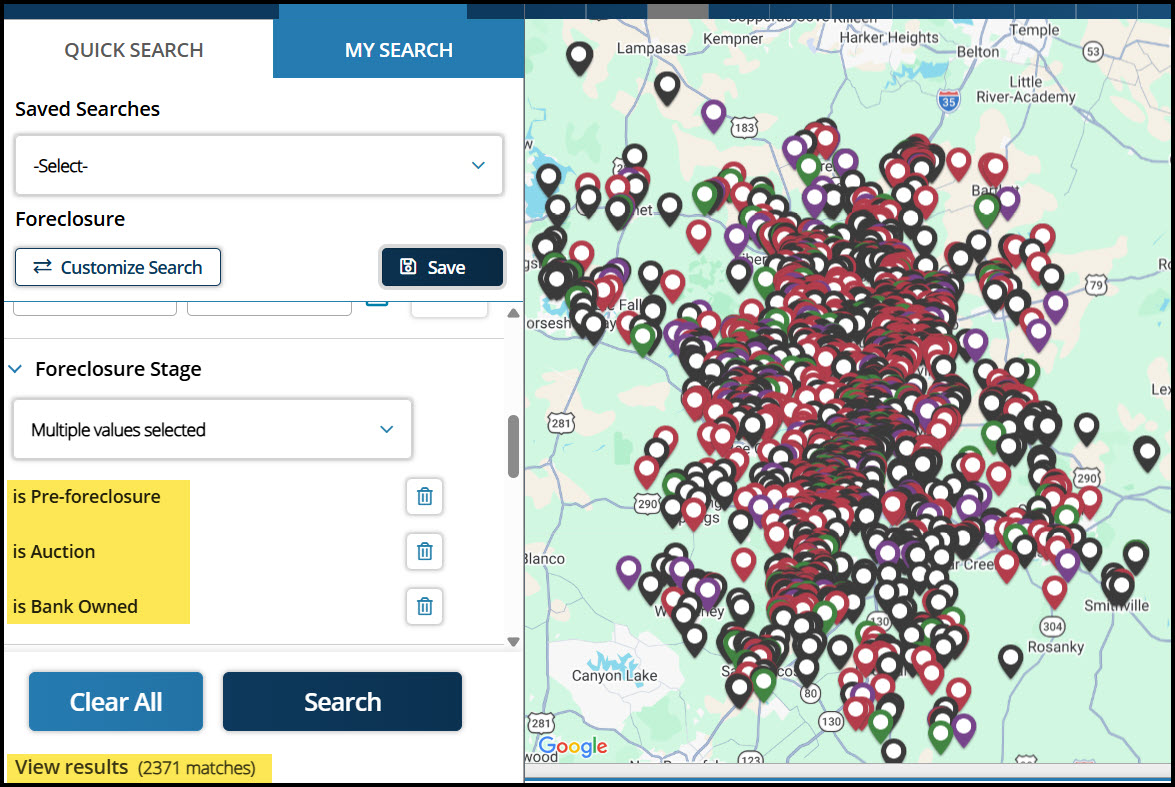
Distressed properties in the Austin area rose from 2,334 on January 9, 2026, to 2,371 today, a gain of 37 properties or roughly 1.6 percent in just over two weeks. Looking further back, on September 26, 2025, distressed inventory stood at 2,198 properties. That puts today’s count up 173 properties, or 7.9 percent, in roughly four months. This trend matters not because the numbers are large, but because the direction is persistent.

In Austin real estate analysis, distressed inventory is not a single category. It represents a process. Each stage reflects a different level of financial stress and a different impact on pricing, negotiation leverage, and market psychology.

Pre-foreclosure is the earliest visible stage of distress. These are properties where payments have been missed and a notice has been filed, but the homeowner still controls the property. Many pre-foreclosures never become forced sales. Owners may cure the default, modify the loan, or sell before the situation escalates. That makes pre-foreclosure a leading indicator rather than an outcome. Rising counts here suggest household strain is increasing, even if it has not yet translated into supply hitting the open market.

Auction is the next step if the issue is not resolved. At this stage, timelines compress and flexibility disappears. Properties moving toward auction face sharply reduced optionality, and buyers expect pricing discounts to compensate for risk and speed. Listings in this phase signal that stress is no longer theoretical. It is becoming transactional.

Bank-owned properties, often referred to as REO, represent the final stage. These are homes that did not sell at auction and are now owned by the lender. Banks are not price optimizers. They are inventory managers. When REO inventory rises, it tends to reset local pricing expectations because liquidation, not market testing, becomes the priority.

When we track total distressed inventory in the Austin real estate market, we are measuring the entire stress pipeline, not just foreclosures. This distinction is critical. A rise in distressed inventory does not mean foreclosures are surging tomorrow. It means more properties are entering or advancing through the pressure funnel.

The recent increase in distressed inventory is occurring alongside elevated overall supply and slower transaction velocity. That combination limits exit options for owners under pressure. Refinancing is harder, holding costs remain high, and days on market remain extended in many submarkets. In this environment, even modest growth in distressed listings matters.

Distressed properties exert influence through price gravity. They anchor buyer expectations lower, particularly in price-sensitive segments of the Austin housing market. They weaken seller leverage nearby, extend negotiation timelines, and cap near-term upside for surrounding non-distressed listings. This is how market corrections persist without dramatic headlines.

Importantly, the rise in distressed inventory is happening after much of the peak-to-trough price correction has already occurred. That signals the issue is no longer just price discovery. It is affordability and cash-flow stress. Owners who bought late in the cycle or carry high payment-to-income ratios are increasingly constrained.

This is not a foreclosure wave. Absolute numbers remain small relative to total housing stock. But the trajectory confirms that financial strain is widening at the margins of the Austin real estate market. If this trend continues through 2026, distressed inventory will play a larger role in shaping pricing, especially in submarkets where affordability is already stretched.

The Austin housing market does not reset through crashes. It resets through time, friction, and incremental pressure. Distressed inventory is one of the clearest signals of that process unfolding.

FAQ: Austin Distressed Housing Market

What counts as a distressed property in the Austin real estate market

Distressed properties include homes in pre-foreclosure, foreclosure auction, or bank-owned status. These stages represent a progression of financial stress rather than a single outcome. Tracking all three provides a fuller picture of pressure building in the Austin housing market.

Is rising distressed inventory a sign of a housing crash in Austin

No. Rising distressed inventory signals increasing financial strain, not a crash. Current levels remain low relative to total housing stock, but persistent growth can extend price corrections and limit upside in the Austin real estate market.

Why pre-foreclosures matter more than foreclosures

Pre-foreclosures are an early warning indicator. They show where payment stress is emerging before forced sales occur. In Austin housing trends, changes in pre-foreclosure often lead shifts in auctions and REO inventory.

How do distressed homes affect Austin home prices

Distressed homes influence pricing by anchoring buyer expectations lower. Even when they represent a small share of inventory, they weaken nearby seller leverage and increase negotiation pressure across the Austin property market.

Will distressed inventory keep rising in 2026

If affordability remains tight and transaction volume stays below historical norms, distressed inventory is likely to continue rising gradually. This would reinforce pricing friction rather than trigger sudden declines in the Austin real estate forecast.

  • Austin real estate
  • Austin housing market
  • Austin housing trends
  • Austin real estate market
  • austin real estate forecast
  • Austin home prices
  • austin distressed properties
  • austin pre foreclosure
  • Austin Housing inventory
  • Austin property market
  • Austin real estate report
  • Austin market update
  • Austin housing data
  • Texas housing trends
  • Central Texas real estate

Related Articles

Keep reading other bits of knowledge from our team.

    Request Info

    Have a question about this article or want to learn more?