Austin Housing Market Update: Activity Index Breaks Above 20% After Seven-Month Slump
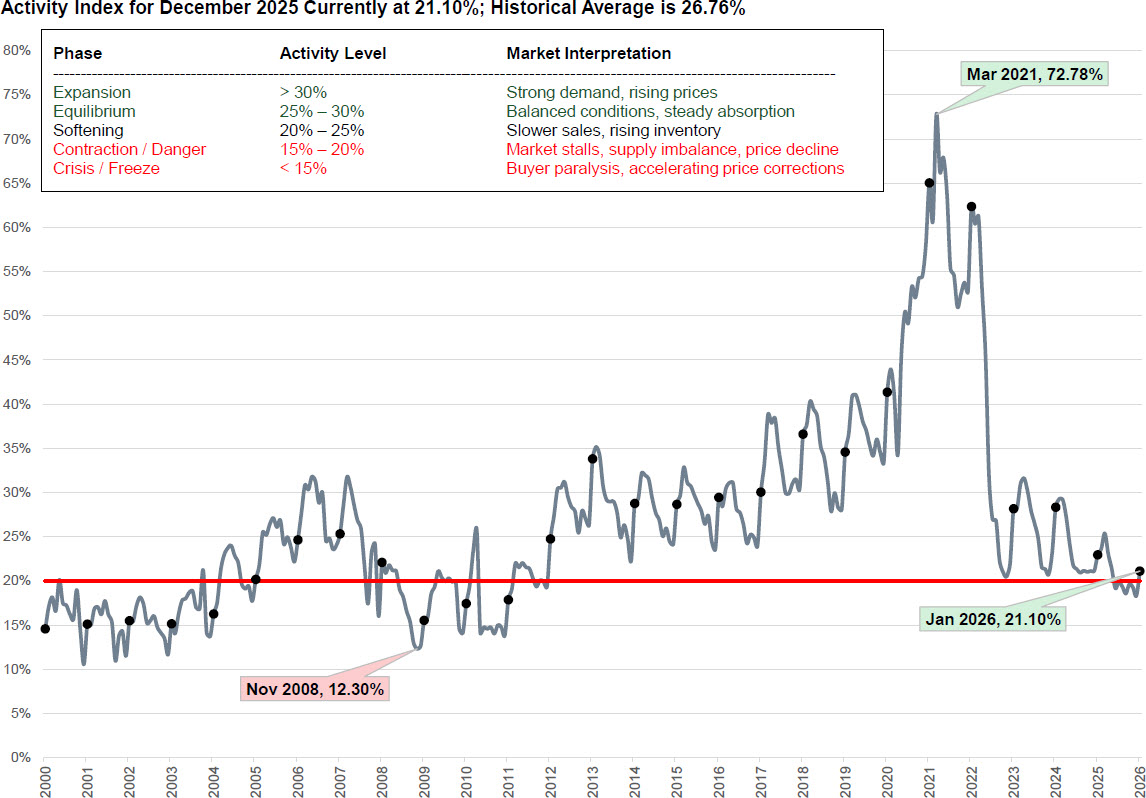
The Austin housing market just crossed an important technical threshold that signals early stabilization, even as broader conditions remain soft. In January 2026, Austin’s Activity Index, defined as pending listings divided by total active plus pending listings, rose to 21.1%. While this reading is lower than the same period last year and still well below the long-term historical average of 26.76%, it marks the first move back above 20% after seven consecutive months below that level. For the Austin real estate market, that shift matters.
The Activity Index has proven to be one of the most reliable measures of real-time demand in the Austin housing market because it directly captures buyer absorption relative to available supply. Unlike price metrics, which lag actual market behavior, this index responds quickly to changes in buyer engagement. A rising Activity Index does not signal a strong market on its own, but it does indicate that demand is no longer deteriorating.
From a historical perspective, Austin has spent long stretches above 25% during periods of balanced or expanding market conditions. From 2012 through early 2020, the index frequently oscillated between 25% and 35%, reflecting steady absorption and manageable inventory growth. During the pandemic-era surge in 2020 and 2021, the index reached unprecedented levels, peaking at nearly 73% in March 2021. That period represented extreme demand distortion rather than a sustainable market baseline.
The reversal began in mid-2022 as mortgage rates rose sharply and affordability constraints intensified. By late 2022 and into 2023, the Activity Index retreated into the low-20% range, signaling a market shifting away from seller dominance. In 2024 and most of 2025, conditions worsened further. The index spent seven straight months below 20%, a zone historically associated with contraction, supply imbalance, and persistent pricing pressure.
January 2026 breaks that streak.
At 21.1%, the Austin Activity Index now sits back in the lower end of the softening range. This is still well below equilibrium and far from expansion, but it represents a meaningful directional change. The market has moved out of contraction and into early stabilization. Buyers are re-engaging selectively, absorption is improving, and inventory is no longer overwhelming demand at the same rate seen in late 2025.
That said, the year-over-year comparison reinforces that this remains a cautious market. January 2025 posted an Activity Index of approximately 22.9%, meaning current absorption is still weaker than last year. This confirms that the improvement is sequential rather than cyclical. The Austin real estate market is stabilizing from a lower base, not accelerating into growth.
The historical average provides additional context. With a long-term mean near 26.76%, today’s 21.1% reading remains materially below what would be considered normal for Austin housing trends. Markets operating at or near the historical average tend to see steadier pricing, fewer forced reductions, and more predictable transaction velocity. Until the Activity Index moves closer to that range, sellers should continue to expect negotiation and longer marketing timelines.
The data also reinforces why price behavior across the Austin property market has remained under pressure. Sustained sub-25% absorption aligns with rising price reductions, elevated months of inventory, and limited upward pressure on austin home prices. Even with the recent improvement, demand has not reached levels necessary to reverse those dynamics meaningfully.
However, it is important to distinguish stabilization from recovery. The Austin housing market is no longer weakening at the same pace, but it is not strengthening either. The Activity Index suggests that the floor for buyer engagement may be forming, which historically precedes a period of sideways price movement rather than immediate appreciation.
For buyers, this environment continues to favor patience and leverage. Improved absorption does not eliminate negotiating power, especially with the index still far below historical norms. For sellers, the data reinforces the importance of precision. Pricing that aligns with current absorption trends is still required to generate activity, even as outright buyer paralysis eases.
For agents and analysts tracking Austin real estate trends, the key takeaway is direction rather than magnitude. The move back above 20% ends a prolonged contraction phase and signals early stabilization. But with year-over-year weakness and a sizable gap from long-term averages, the broader Austin real estate forecast remains one of balance-seeking rather than expansion.
The Activity Index will be worth watching closely over the next several months. Sustained readings above 20%, followed by movement toward 23% to 25%, would confirm a more durable shift. Failure to hold above this threshold would suggest that January’s improvement was temporary rather than structural.
For now, the data is clear. The Austin housing market is no longer deteriorating, but it has not yet healed.
FAQ: Austin Activity Index and Market Trends
What is the Activity Index in the Austin housing market?
The Activity Index measures pending listings divided by the total of active and pending listings. It captures real-time buyer absorption and is a leading indicator of demand in the Austin real estate market.
Why is crossing above 20% important for Austin real estate?
Historically, Activity Index readings below 20% align with market contraction and price pressure. Moving back above 20% signals stabilization and improving absorption, even if conditions remain soft.
Is the Austin housing market improving or recovering?
The data indicates stabilization, not recovery. While demand is no longer worsening, the Activity Index remains below historical averages and year-over-year levels, limiting upward pressure on austin home prices.
How does today’s Activity Index compare to historical norms?
The long-term historical average is approximately 26.76%. January 2026’s 21.1% reading is meaningfully below normal, indicating the market is still operating below equilibrium.
What does this mean for Austin real estate trends in 2026?
If the Activity Index holds above 20% and trends upward, it would support a period of market balance and price stabilization. Without further improvement, pricing pressure is likely to persist across the Austin property market.