Austin Housing Market Projection (2026–2028): The Logic Behind Why Prices Must Fall
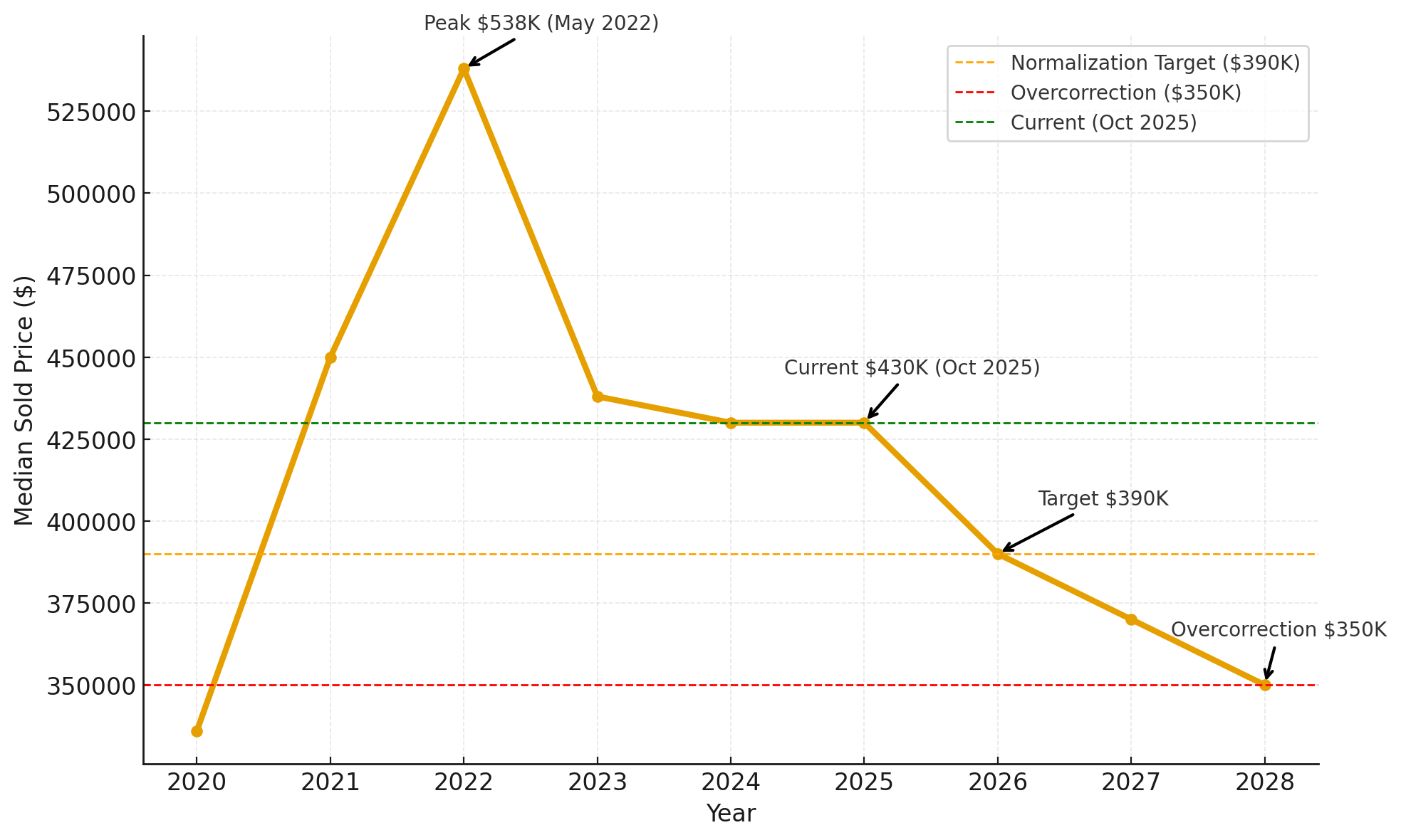
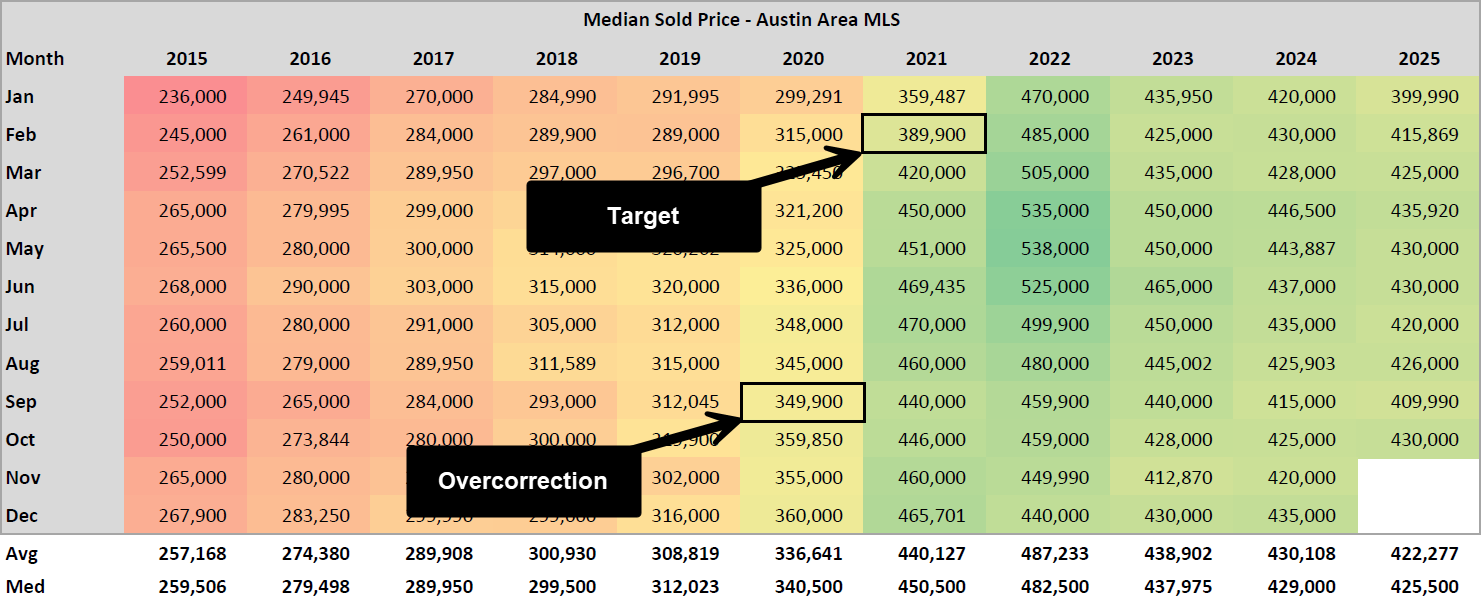
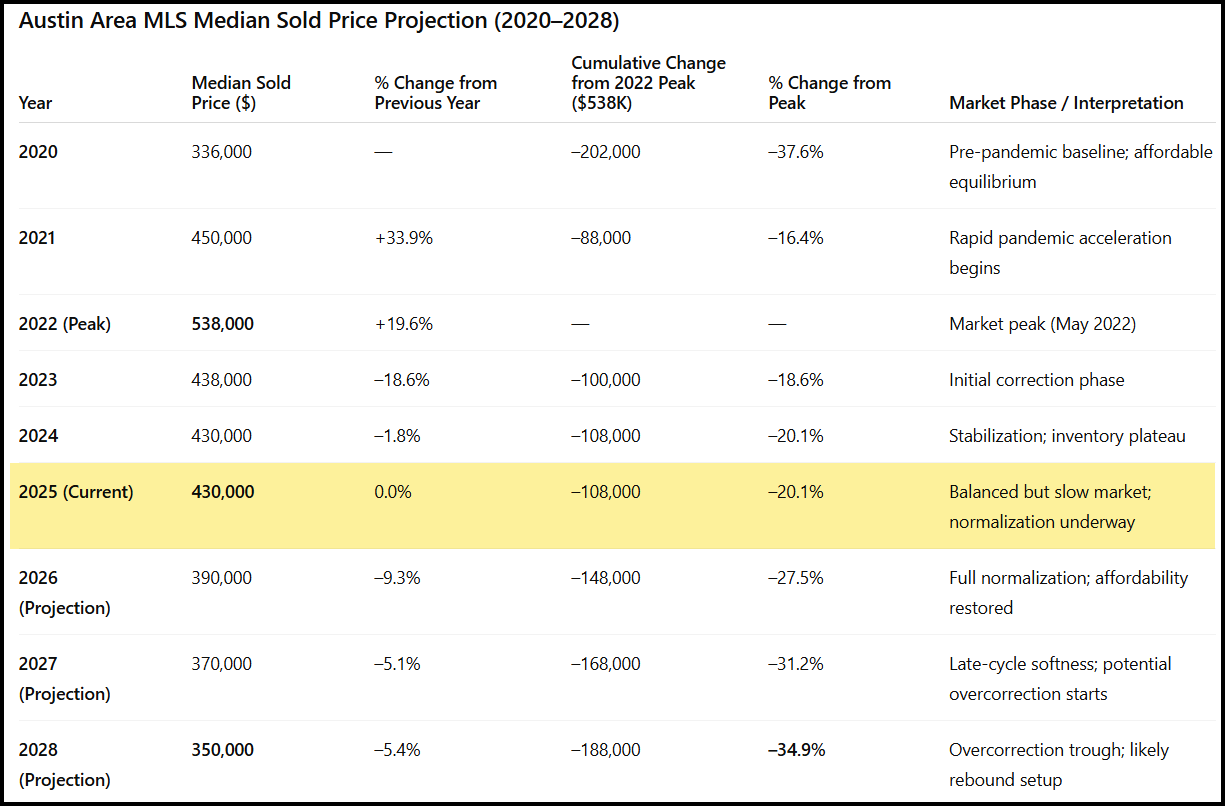
The Austin housing market stands at a crossroads — one defined not by speculation, but by mathematics. After peaking at a median sold price of $538,000 in May 2022, the Austin Area MLS has declined to $430,000 as of October 2025, marking a 20.1% pullback. Yet, despite the price correction, affordability metrics still tell a more sobering story: the market remains overheated, and further normalization is not just possible — it’s logical.
The Affordability Equation Hasn’t Reset
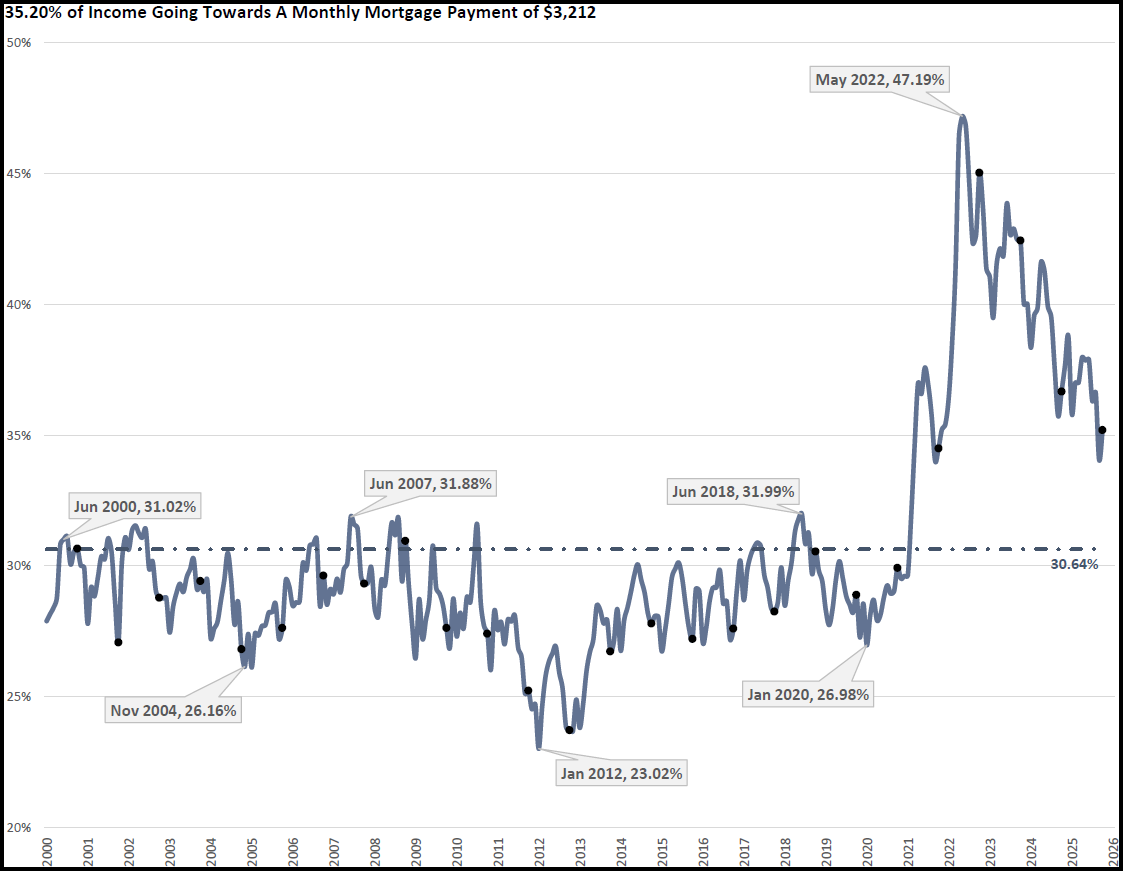
Affordability, not emotion, defines the direction of real estate markets. As of fall 2025, the average Austin-area household spends 35.2% of income on a monthly mortgage payment of approximately $3,200, assuming a 20% down payment and prevailing interest rates. Historically, Austin’s affordability ratio has hovered near 30.6%, with past market peaks — 2000, 2007, and 2018 — clustering around the 31% threshold.
At the market’s apex in May 2022, that ratio reached 47.2%, the highest in Austin’s modern history. Even after three years of price declines, the cost of ownership remains far above sustainable norms. Mortgage rates are no longer falling, wage growth has slowed, and inflation-adjusted household income has plateaued. That leaves only one lever to restore equilibrium — pricing.
Applying Occam’s Razor: The Simplest Explanation Wins
Occam’s Razor, the philosophical principle of parsimony, teaches that the simplest explanation is usually the correct one. When applied to the Austin real estate market, it presents three possible scenarios to restore balance:
Interest rates drop back to 3–4% — which would require a deep recession and full reversal of monetary policy.
Household incomes rise 25–30% in two years — which has never occurred in Austin’s modern economic cycle.
Home prices continue to decline — a process already in motion, requiring no extraordinary economic event.
By Occam’s logic, the third outcome is the most probable. Rates are unlikely to collapse, incomes won’t spike, and affordability still sits above the 35% mark. The simplest and most statistically consistent path forward is further price erosion until affordability returns to sustainable levels near 30%.
The Mathematical Reality of “Must Fall”
At today’s median price of $430,000, Austin’s affordability ratio remains roughly 9–10% above its long-term equilibrium. A decline to $390,000 — projected between late 2026 and early 2027 — would restore balance, reducing the typical payment-to-income share to about 31%.
If the market overshoots, as housing markets often do, a short-lived drop to $350,000 would represent a 34.9% total correction from peak — returning prices to their inflation-adjusted 2019–2020 equivalents. This outcome would likely mark an overcorrection rather than a collapse, paving the way for a rebound as affordability reopens demand channels.
The Data Behind the Decline
The October 31, 2025 Austin Daily Real Estate Briefing reported 16,323 active residential listings, a 17.3% increase year over year, with nearly 60% experiencing price reductions. The Activity Index stands at 19.1%, signaling subdued absorption, and Months of Inventory rose to 5.79, up from 4.97 the prior year.
These indicators confirm a sustained imbalance favoring buyers. Historically, when inventory exceeds six months and absorption drops below 20%, the market experiences continued price compression of 1–2% per month until absorption rebounds. If those dynamics persist, Austin’s median price trajectory toward $390K by 2027 appears not just likely, but data-driven.
The Psychology and Timing of Overcorrection
Real estate cycles rarely end cleanly. Markets tend to overcorrect before stabilizing, driven by psychology more than fundamentals. Sellers cling to outdated valuations, buyers hesitate, and transaction volume slows to a crawl — producing temporary price undershoots before recovery.
The affordability data reflects this lag clearly. In prior cycles, affordability ratios above 31% have consistently preceded 12–24 months of price adjustment. Today’s 35% reading indicates Austin’s market is still completing that process. Once the ratio returns near 30%, stability typically follows.
The Long-Term Equilibrium Path
The Austin market’s 25-year compound appreciation rate of 4.85% provides a statistical foundation for equilibrium modeling. Projected forward from 2020’s baseline, the sustainable 2026–2028 valuation corridor aligns near $390K–$400K. Temporary dips below that range — toward $350K — would represent short-term undervaluation phases typical of cyclical troughs.
By late 2027 or early 2028, as inventory tightens and mortgage rates stabilize near 6%, Austin is likely to transition into the early stages of its next appreciation cycle. Historically, each Austin downturn has been followed by 24–36 months of recovery as affordability and population growth re-align.
A Logical, Not Emotional, Market Outlook
The Austin housing market isn’t collapsing — it’s in a sustained and severe correction. The extraordinary price acceleration of 2020–2022 pushed affordability metrics far beyond sustainable limits. What follows is not panic but parsimony: the simplest, most probable outcome. Under Occam’s Razor, the market’s path forward doesn’t depend on miracles or policy intervention. It depends on arithmetic. Rates will not halve. Wages will not surge. Prices, therefore, must adjust to restore balance — a process already underway. By 2028, the Austin real estate market will likely emerge leaner, more stable, and fundamentally stronger — not because it defied the math, but because it finally respected it.
FAQ Section
1. Why do prices “have” to fall further?
Because affordability remains historically stretched. Austin households still spend over 35% of income on housing, versus a 30% norm. Unless rates collapse or wages surge, prices must adjust to restore equilibrium.
2. Could lower interest rates fix this without price declines?
Unlikely. Mortgage rates would need to drop to the 3–4% range — a level inconsistent with current economic policy. With inflation sticky and the Fed focused on stability, prices are the variable most likely to move.
3. What happens if the market overcorrects to $350K?
That scenario would represent temporary undervaluation. Historically, Austin rebounds quickly after overshooting. Once affordability improves and inventory clears, appreciation typically resumes within two years.
4. How does inventory play into this?
With over 16,000 active listings and absorption under 20%, supply continues to outpace demand. Until that reverses, the market naturally favors buyers, leading to additional price pressure.
5. When will the market find its bottom?
Current trends suggest a bottom forming around late 2026 to early 2027. That would mark the end of the affordability correction and the beginning of a more sustainable growth phase.