Austin Real Estate Market: November 2025 Price Trends and Long-Term Corrections
The Austin real estate market closed November 2025 with one of the clearest signs of stabilization we’ve seen since the post-pandemic correction began. Prices continue to hover in a narrow range, seasonal patterns have normalized, and the dramatic highs of 2022 are firmly in the rearview mirror. By looking closely at long-term price-per-foot data and comparing today’s numbers to Austin’s 10-year high, we get a precise picture of where Austin housing stands and where the market is most likely heading.
Austin home prices, measured through median price per square foot, provide a clean, mix-shift-neutral view of real trends. The November 2025 reading of $283 per square foot fits neatly within the same pattern that has held for almost three years: a soft, steady, affordability-limited market where sellers and buyers find equilibrium not through rapid appreciation or steep declines, but through predictable seasonality and narrow month-to-month movement. For anyone tracking the Austin real estate market or reviewing Austin housing trends for forecasting, the numbers are consistent and highly revealing.
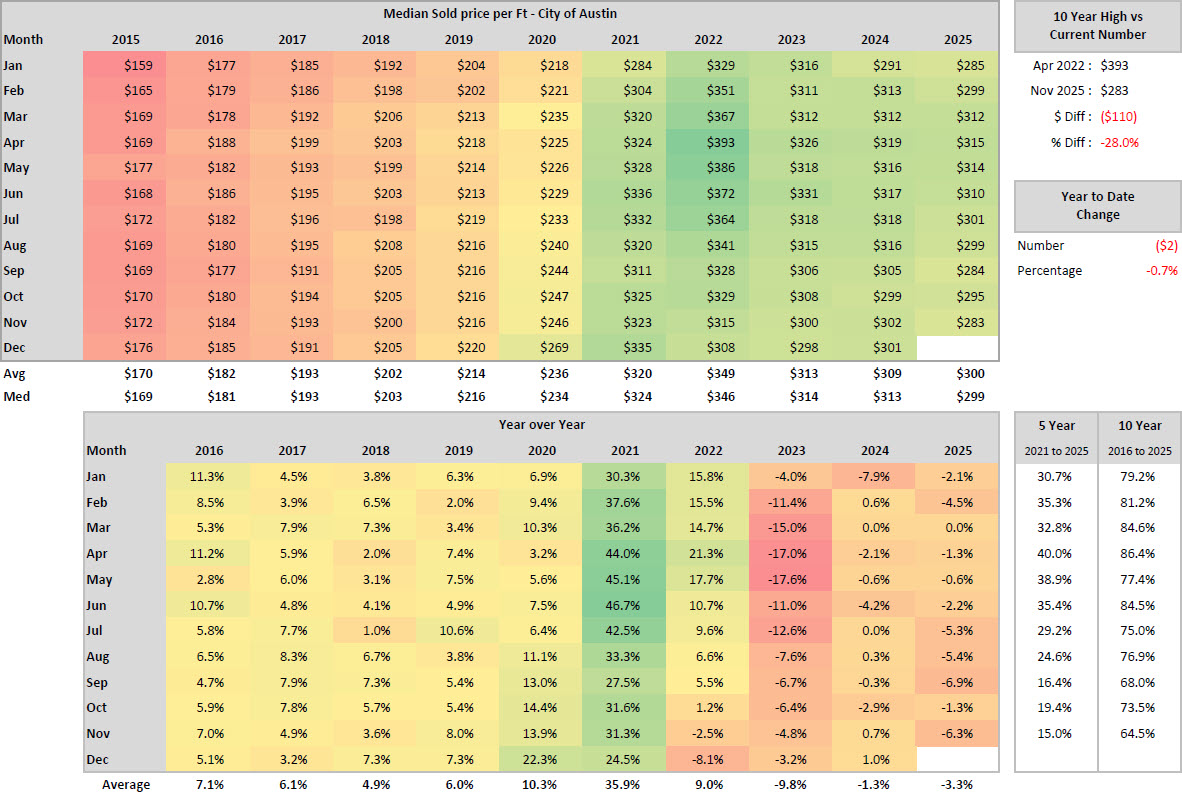
To understand today’s Austin housing conditions, it’s useful to revisit the market’s high-water mark. The 10-year peak landed in April 2022 at a median $393 per square foot. This month remains the ceiling of the Austin property market—a moment defined by extreme demand, historically low mortgage rates, and a supply squeeze that no longer exists. When we compare that peak to November 2025’s $283, Austin real estate is sitting 28 percent below its high. This $110-per-foot decline marks a complete unwinding of the pandemic-era surge and aligns with what we see across the entire price-per-foot timeline from 2015 through 2025.
Even with this large peak-to-current correction, the 2025 year-to-date change is almost flat. Austin started January 2025 at $285 per square foot. November closed at $283. That is only a $2 decline over eleven months, or a 0.7 percent drop. This stability speaks volumes. The Austin market already absorbed its major reset in 2022 and 2023. What we’re seeing today is a market that is not appreciating, not collapsing, and not behaving irrationally. Instead, it is behaving exactly like an affordability-constrained environment where higher inventory levels and elevated mortgage rates limit upward movement while strong long-term demand prevents severe price declines.
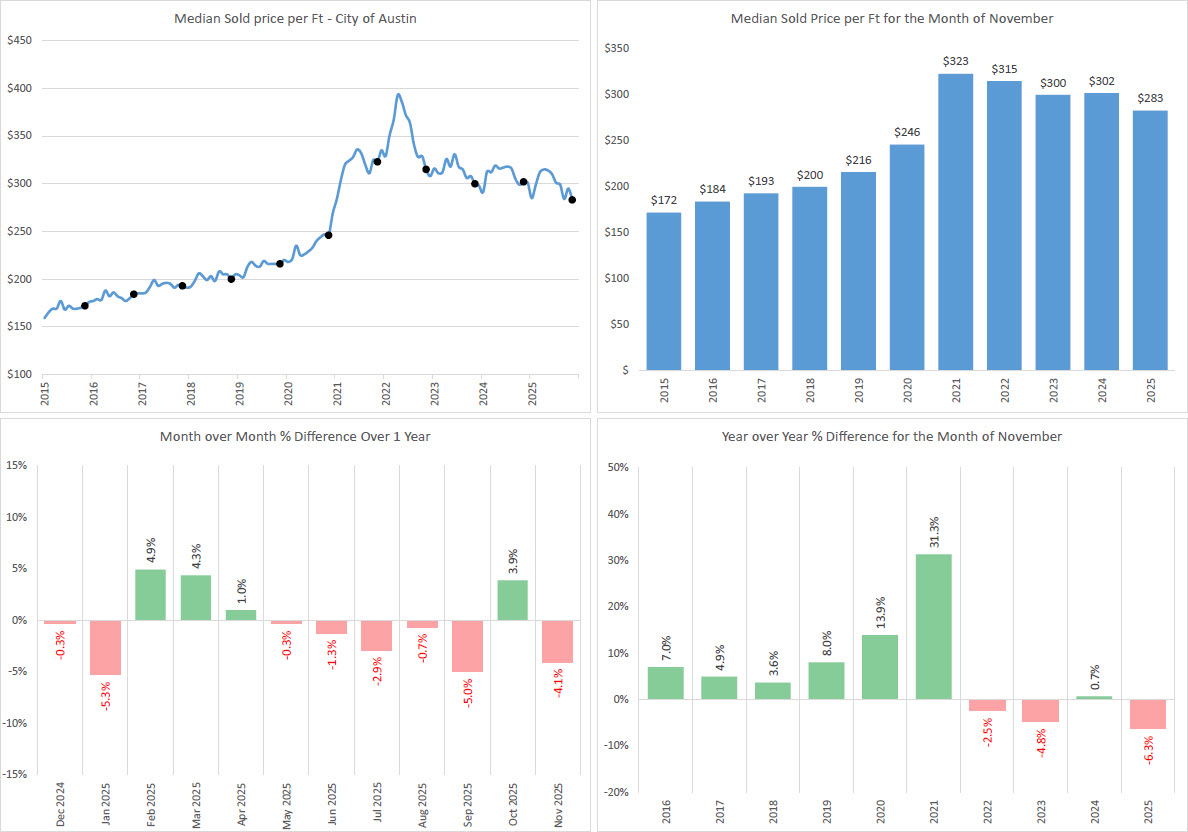
The long-term dataset from 2015 to 2025 reinforces this point clearly. The stretch from 2015 through 2019 shows predictable year-over-year increases in the $160s, $170s, and low $200s. By 2020 and 2021, the Austin real estate market accelerated sharply, with 2021 readings frequently in the low to mid-$300s. The 2022 surge took prices to unprecedented levels, including the $393 peak in April. But after that blow-off year, the market recalibrated quickly. The price-per-foot cycle in 2023 returned to the low $300s. By 2024, averages settled just above $300. In 2025, the range is even narrower, typically between $280 and $315.
This narrowing range is one of the most important Austin real estate trends of the past decade. It shows that the volatility is gone. Austin home prices are now defined by stability rather than acceleration or contraction. The seasonality visible in the chart confirms this. Each year, March through June produce the highest readings. Each winter, the market slips mildly. The key difference in the 2023–2025 period is that the gap between the seasonal high and low has shrunk. This indicates softer demand, higher inventory relative to buyers, and affordability ceilings that cap the market long before it approaches its old peak.
When comparing peak months between years, the change becomes clearer. In 2023, April hit $326 per square foot. In 2024, April reached $319. In 2025, April topped at $315. These small step-downs show that while the Austin housing market isn’t falling sharply, it also isn’t recovering toward the upper $300s. The data instead point to a prolonged normalization phase where Austin real estate prices adjust to income levels and borrowing costs rather than emotional bidding.
The most compelling insight from the data is how closely today’s market resembles late 2020 and early 2021—before the frenzy fully erupted. Those years also showed prices in the mid-$200s to low $300s, aligning with the $283 reading we see today. It suggests that while Austin remains more expensive than the mid-2010s, the unsustainable pricing of 2022 has been fully corrected. Buyers who entered the market between March 2022 and June 2022 bought at the peak; everyone else is operating in a fundamentally different environment.
Another important takeaway is that the Austin real estate forecast remains tied to inventory, not demand surges. Prices will stay in this tight band unless the number of active listings pushes materially higher. To move outside the $280–$315 range, the market would need a meaningful decline in available homes or a significant drop in mortgage rates. Without either of those tailwinds, the Austin housing market will continue tracking sideways, driven by affordability constraints and buyer selectivity.
With November 2025 closing at $283 per square foot and year-to-date prices down less than one percent, the message for buyers, sellers, and investors is simple: this is a stable, balanced, post-correction market. Sellers who price realistically within the current range will find buyers. Buyers who require value, concessions, or time to evaluate options have more negotiating room than they did in past years. Investors can underwrite with more confidence because the volatility that defined the early 2020s has largely exited the system. The Austin housing market is steady, predictable, and driven by fundamentals, not frenzy.
For clients and agents trying to understand where Austin home prices sit today, the numbers provide clarity. We are well below the 2022 peak, modestly below 2023 and 2024 highs, and essentially flat throughout 2025. The Austin real estate market is functioning normally again—and that normal looks nothing like the pandemic cycle. It looks like a market that has fully reset and now moves in rational, data-driven steps.
FAQ What is driving Austin home prices in late 2025?
Austin home prices in late 2025 are driven primarily by affordability limits and sustained inventory levels. The November median of $283 per square foot reflects a market that has completed its post-2022 correction and settled into a stable range. Higher borrowing costs keep ceilings in place, while steady population growth prevents deeper declines. The result is a balanced Austin housing market with predictable seasonal behavior.
How far are Austin home prices from the 2022 peak?
Austin home prices are 28 percent below the 2022 peak. The highest recorded median price per square foot was $393 in April 2022, compared to $283 in November 2025. This $110 difference represents the full reversal of the pandemic-era surge. Today’s levels are much closer to late 2020 and early 2021 conditions.
Is the Austin real estate market still declining?
No. The market is not in a decline phase. Austin real estate is effectively flat in 2025, with only a 0.7 percent year-to-date drop from January to November. Prices have stabilized within the $280–$315 range for nearly three years. The major correction occurred earlier, and the market is now in a sideways consolidation.
What does this mean for buyers entering the Austin market?
Buyers entering the Austin market today are operating in a high-clarity environment. Prices are stable, competition is moderate, and inventory is strong enough to allow negotiating leverage. This makes it easier to secure properties without urgency or bidding pressure. Buyers can evaluate long-term value using predictable trends rather than speculative spikes.
Will Austin home prices rise in 2026?
Whether Austin home prices rise in 2026 depends almost entirely on inventory and borrowing costs. Without a significant reduction in supply or meaningful drop in mortgage rates, Austin home prices are likely to remain in the same stable band seen throughout 2023–2025. Any appreciation will be modest and tied to affordability improvements rather than market momentum.