Austin Housing Affordability Has Corrected Sharply, and the Data Explains Why
The Austin housing market has undergone one of the most significant affordability corrections in its modern history, and the numbers now tell a very different story than they did just a few years ago. While many conversations still focus on peak-era prices or interest rate headlines, the most important affordability metric, the relationship between home prices and household income, shows that the Austin real estate market has already worked through much of its excess.
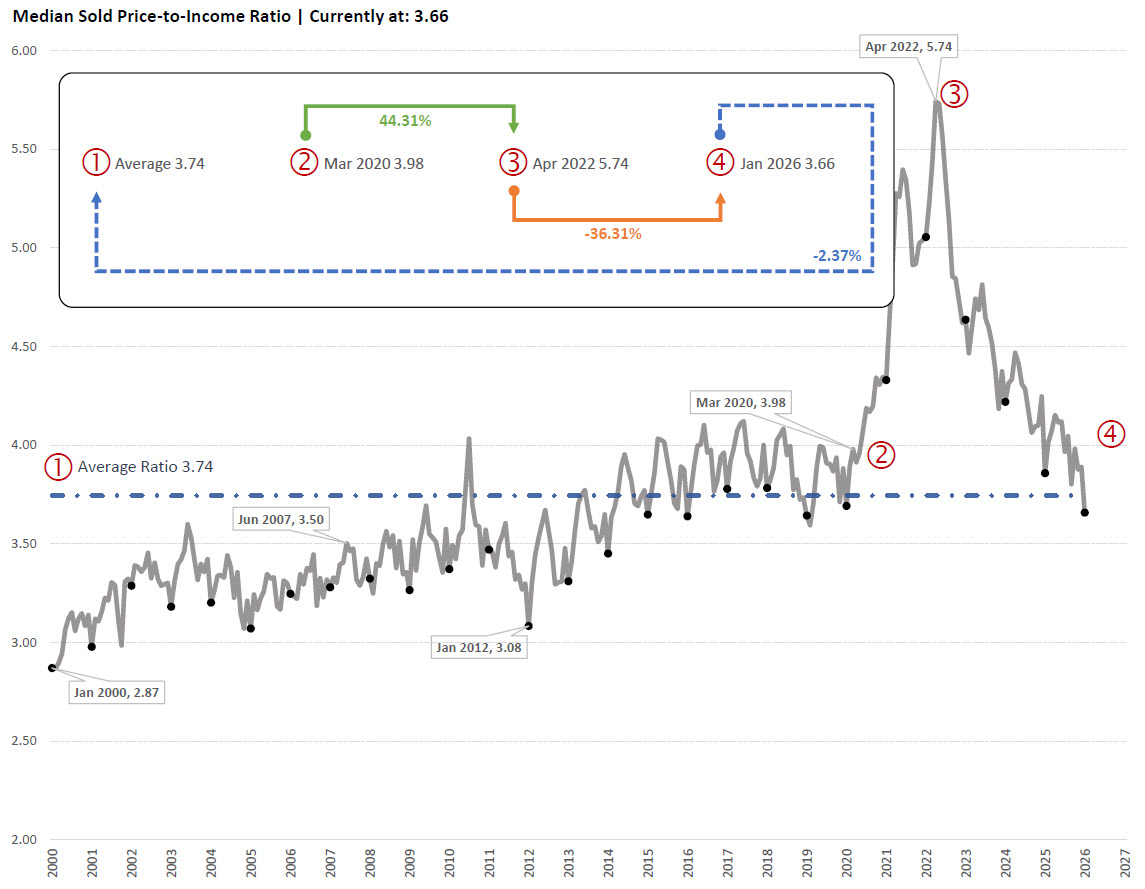
Measured through the median sold price-to-income ratio, Austin housing affordability has improved materially since the 2022 peak. This ratio compares what buyers are paying for homes relative to what households earn, providing a clearer picture of affordability than prices or mortgage rates alone. As of January 2026, the ratio stands at 3.66, down 36.31 percent from its April 2022 peak of 5.74 and now slightly below the long-term average of 3.74. In practical terms, this means Austin home prices have realigned much more closely with local incomes.
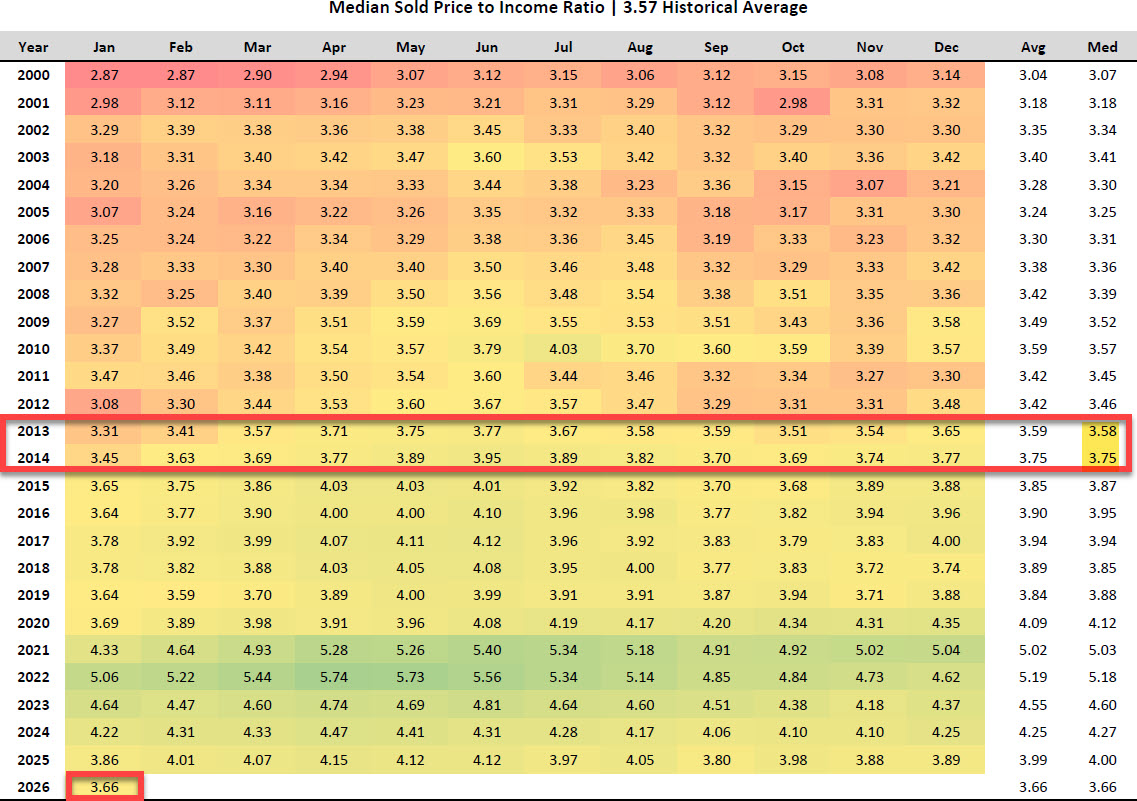
To understand why this matters, it helps to look at history. In 2013, the median sold price-to-income ratio in Austin was 3.58, and in 2014 it was 3.57. Today’s level sits just above those readings and well within the same affordability range that defined the mid-2010s Austin property market. This comparison shows that affordability conditions today resemble a period widely considered balanced and functional, rather than speculative or overheated.
The affordability correction is also visible in monthly mortgage payments. At the peak in June 2022, the estimated principal, interest, taxes, and insurance payment for a median-priced Austin home reached approximately $3,742. By January 2026, that payment had fallen to about $2,951, a decline of more than 21 percent. Year over year, monthly payments are down roughly $219, reflecting a combination of lower prices and stabilizing financing costs. Because buyers qualify and budget based on monthly payments, this shift plays a critical role in restoring demand capacity across the Austin housing market.
Another important measure in the affordability report is the share of household income required to carry a typical mortgage. In mid-2022, monthly housing payments consumed more than 47 percent of median household income, an unsustainable level by any historical standard. Today, that figure has fallen to about 32 percent. Over the past 25 years, Austin housing affordability has typically functioned in the high-20 to low-30 percent range. Returning to this band indicates that the market is once again operating within a historically workable framework for buyers.
What makes this correction notable is how it occurred. The data shows that income growth remained relatively steady over time, while affordability improved primarily through price adjustment rather than income distortion. This distinction matters because price-led corrections tend to produce more stable outcomes than temporary income spikes or short-lived financing incentives. It suggests that the current Austin real estate market is rebuilding on firmer ground rather than relying on external supports.
The median sold price-to-income ratio further reinforces this point. Although nominal home prices remain well above pre-pandemic levels, their relationship to income has reverted toward long-term norms. From 2000 through 2019, Austin’s affordability ratios fluctuated within a relatively narrow band, with only brief deviations. The 2021–2022 period stands out as an extreme outlier. The subsequent decline has erased much of that distortion, bringing affordability closer to historical precedent.
This shift has important implications for the Austin real estate forecast. Markets typically regain transactional stability not when prices bottom, but when affordability metrics return to ranges buyers can sustain. The data now shows that threshold has largely been reached. While this does not imply a rapid price rebound or a return to aggressive appreciation, it does indicate that the structural imbalance that limited buyer participation has eased considerably.
For participants in the Austin housing market, this environment rewards realism and alignment rather than speculation. Buyers face conditions that are materially less restrictive than at peak stress, while sellers must recognize that pricing power is now governed by income-based affordability rather than past highs. Investors evaluating the Austin property market should also note that income-adjusted valuations are no longer historically stretched, reducing downside risk compared to peak-cycle conditions.
Viewed through the lens of affordability rather than sentiment, the Austin housing market today looks far more stable than many assume. The correction has already occurred in the metric that matters most. As a result, current market behavior is increasingly shaped by fundamentals rather than excess.
FAQ: Austin Housing Affordability and Market Conditions
Is Austin housing affordability improving?
Yes. Based on the median sold price-to-income ratio, Austin housing affordability has improved significantly since 2022. The ratio has fallen more than 36 percent from its peak and now sits slightly below the long-term average, indicating a meaningful correction.
How does today’s Austin real estate market compare to past years?
When measured against income, current affordability levels are similar to those seen in 2013 and 2014. This places today’s market closer to mid-2010s conditions rather than the extreme levels observed during the pandemic housing surge.
Are Austin home prices still too high?
While nominal prices remain elevated compared to pre-2020 levels, their relationship to household income has corrected substantially. Affordability metrics suggest prices are no longer disconnected from what buyers earn.
What role do mortgage payments play in affordability?
Monthly mortgage payments have declined more than 20 percent from their 2022 peak. Because buyers qualify and budget based on payments rather than prices alone, this reduction has materially improved access to the Austin housing market.
What does this mean for the Austin real estate forecast?
Affordability corrections often precede periods of market stabilization. While rapid appreciation is unlikely in the near term, the data suggests the market is operating on a more sustainable foundation than during the peak years.