Austin Foreclosures Hit a 7-Month High: 2,625 Distressed Properties Now Tracked Across the Six-County Austin Metro
Published by Team Price Real Estate | Austin Metro Distressed Property Tracker | April 27, 2026
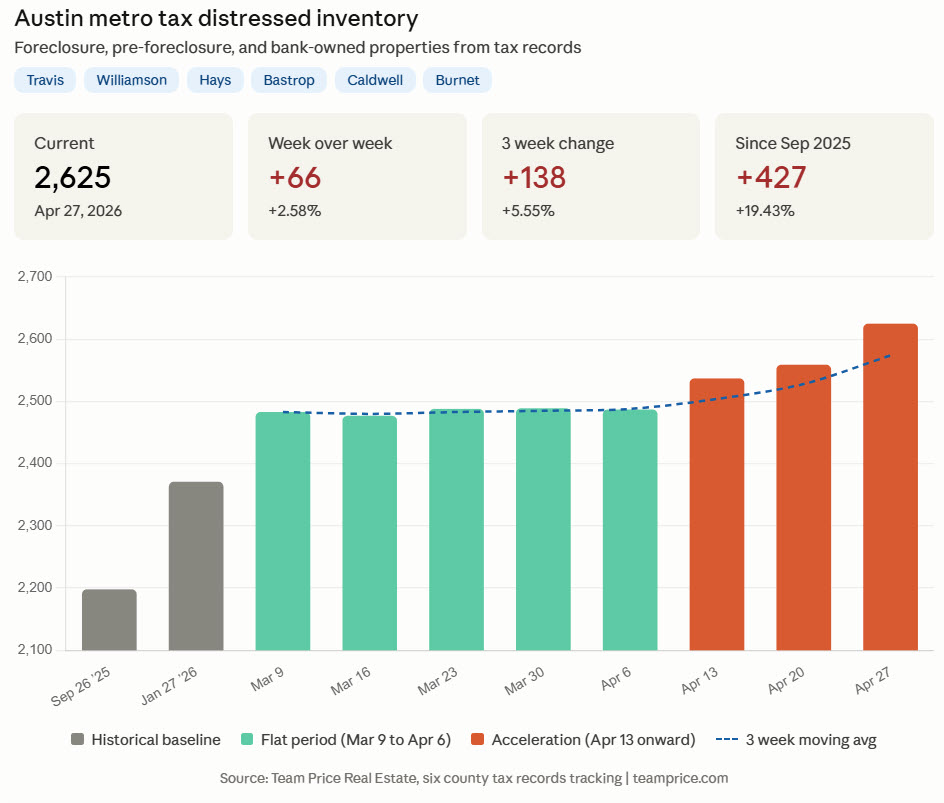
The Austin metro distressed property pipeline just posted its largest single-week increase of the year. As of April 27, 2026, public tax records across the six-county Austin MSA show 2,625 properties classified as foreclosure, pre-foreclosure, or bank-owned, an increase of 66 properties in seven days and 138 properties over the past three weeks.
That brings the six-county Austin metro distressed count to a seven-month high, up 19.4% from the September 2025 baseline of 2,198. More importantly, the trend has just broken decisively out of a four-week plateau, signaling that financial stress is not stabilizing in Central Texas. It is accelerating.
From March 9 through April 6, the distressed count moved within an extremely tight range of 2,477 to 2,489, a 12-property spread over four weeks that effectively represented a flat market. Then April 13 added 50 properties, April 20 added 22, and April 27 added another 66. That is the largest single-week increase in the dataset and represents a +5.55% move in just three weeks.
What These Numbers Actually Represent
The 2,625 properties tracked here are pulled from public tax records, not the MLS. This is a critical distinction.
Tax record data captures properties at every stage of the foreclosure pipeline:
Pre-foreclosure: A homeowner has defaulted on their mortgage and the lender has issued a notice of default. The owner still holds title and can sell, refinance, or cure the default.
Foreclosure / Auction: The property is scheduled for public foreclosure sale. In Texas, these auctions occur on the first Tuesday of each month at the county courthouse.
Bank-Owned (REO): The property failed to sell at auction and reverted to the lender. The bank now owns it and is motivated to dispose of it.
What makes this dataset more powerful than MLS-only foreclosure searches is that the vast majority of distressed properties never appear on the MLS, or they only surface after months of internal lender asset management. Recent analysis showed that of 2,477 distressed properties in tax records, only about 110 were active MLS listings. That's roughly 95% of the distressed pipeline operating outside the public listing system.
Why the Surge Is Happening Now
A few converging dynamics explain the timing of this spring 2026 acceleration:
Texas property tax delinquency timing. Property tax bills go out in October. They become delinquent on February 1, with penalties and interest compounding monthly thereafter. By April, owners who could not cure their delinquency are roughly three months in, with an additional 9% to 10% in penalties and interest stacked on top of the original bill. Owners who were going to resolve typically do so in February or March. Those who could not are now visibly distressed in the data.
The post-peak underwater problem. Many homes purchased between 2021 and mid-2022 at the peak of the Austin price cycle are now worth less than the loan balance, particularly in outer-ring submarkets that saw the steepest corrections. When these homeowners face job loss, divorce, medical events, or rate-driven payment shock, they cannot simply sell their way out. That pushes more of them into pre-foreclosure rather than a normal market sale.
Spring listing pressure. Owners carrying distressed properties through the winter often try to list in March or April to capture peak buyer traffic. Some of the surge represents distress that already existed becoming more visible, rather than entirely new defaults.
Higher mortgage rates and extended days on market. Elevated borrowing costs continue to compress affordability, slow transaction velocity, and apply financial pressure to owners who counted on being able to sell quickly.
Three-Week Acceleration Breakdown
The gap between the flat plateau and the recent surge tells the story:
Flat period average (Mar 9 to Apr 6): approximately +1 property per week
Acceleration period (Apr 13 onward): approximately +46 properties per week
That is a 46x change in weekly velocity over three weeks. Even allowing for noise, the trend is unmistakable. The Austin metro foreclosure pipeline is filling faster than it is clearing.
What This Means for Austin Metro Buyers
For buyers, particularly those who have been priced out of the broader Austin housing market over the past three years, the trend is directionally favorable. More distressed inventory means:
- More motivated sellers. Pre-foreclosure homeowners often need to sell quickly to avoid the financial and credit consequences of full foreclosure. That creates room for negotiation that does not exist in standard transactions.
- More properties priced below market. Bank-owned (REO) properties typically list at or below comparable market values to move them off the lender's books. This puts pricing pressure on adjacent listings as well.
- More inventory across price tiers. With distress showing up across the full six-county metro, buyers in every price range from entry-level to luxury have more options to evaluate.
For buyers willing to accept as-is condition and move quickly, this is the most opportunity-rich Austin metro market since before 2020.
What This Means for Austin Metro Sellers
For sellers of non-distressed homes, the implications are nuanced. If your home is in a neighborhood with several pre-foreclosure or bank-owned properties, those distressed comps will factor into appraisals and buyer negotiations. That doesn't mean you cannot sell at full value, but it does mean pricing precision and presentation become more important than ever.
Sellers in the most affected submarkets should expect:
- More aggressive price negotiation from buyers citing distressed comps
- Longer days on market if priced above the neighborhood's true clearing level
- Increased importance of move-in-ready condition versus distressed competition
Working with an agent who tracks distressed inventory at the submarket level becomes a meaningful competitive advantage in this environment.
What This Means for Austin Metro Investors
For investors, the metro-wide distressed acceleration represents the most active opportunity window in years. Three strategies are most relevant in the current cycle:
Pre-foreclosure direct outreach. With 2,625 properties in some stage of the pipeline and only a small fraction listed on MLS, direct-to-owner outreach in pre-foreclosure can produce off-market acquisitions at meaningful discounts. This requires title research, careful underwriting, and the ability to close quickly.
Courthouse auction (first Tuesday). Texas non-judicial foreclosure auctions happen at each county's courthouse on the first Tuesday of every month. These are cash-only, sold-as-is, with limited inspection access. They are best suited for experienced investors who have done extensive title and property research in advance.
REO acquisition. Bank-owned properties are typically the safest entry point for less experienced foreclosure buyers. They are listed on MLS, come with normal title, and can usually be financed. The trade-off is that competition is higher and discounts are smaller than at the auction or pre-foreclosure stage.
Comparing Austin Metro to the National Foreclosure Picture
National data context matters. ATTOM's national foreclosure reporting has shown filings rising year-over-year for several months, with completed foreclosures (REOs) up 42% nationally in March 2026 versus March 2025. Texas remains among the states with the highest foreclosure start volumes in the country.
The Austin metro is not in a foreclosure crisis. The 2008-2011 cycle, by comparison, saw Austin-area MLS foreclosure and short-sale listings exceed 1,000 active listings on the MLS alone. The current 2,625 distressed-pipeline count across six counties represents a meaningfully smaller share of total inventory than the housing-crisis era.
But the trajectory is what matters. The pipeline is filling at an accelerating rate. The next three to six months of data will determine whether this is a temporary catch-up effect from delayed pandemic-era stress or the early stages of a more sustained increase.
Frequently Asked Questions
How many foreclosures are there in Austin right now?
As of April 27, 2026, public tax records across the six-county Austin MSA show 2,625 properties in pre-foreclosure, foreclosure, or bank-owned status. This represents the highest count in seven months and is up 19.4% from September 2025.
Are Austin foreclosures increasing in 2026?
Yes. The Austin metro distressed property count has risen from 2,198 in September 2025 to 2,625 in April 2026, an increase of 19.4% in seven months. The pace of weekly additions has accelerated significantly in the past three weeks, with the largest single-week increase of the year recorded April 27.
Why aren't all 2,625 distressed properties listed on the MLS?
The foreclosure pipeline does not automatically produce MLS listings. Pre-foreclosure filings are legal notices, not listings. Texas foreclosure auctions take place at county courthouses on the first Tuesday of each month, outside the MLS entirely. Bank-owned properties typically spend weeks or months in internal lender asset management before being assigned to a listing agent. Recent analysis suggests roughly 95% of the distressed pipeline is off-MLS at any given time.
How does the Texas foreclosure auction process work?
Texas uses a non-judicial foreclosure process. When a borrower defaults and the lender follows the required notice procedures, the property is scheduled for auction at the county courthouse on the first Tuesday of the month. Auctions are cash-only, properties are sold as-is, and the winning bidder receives title subject to any senior liens or unpaid taxes. Travis County, Williamson County, Hays County, and the other Austin metro counties each post upcoming auction notices in advance through county tax offices and authorized auction platforms.
Is now a good time to buy a foreclosure in Austin?
The increase in distressed inventory creates more opportunity than the Austin metro has seen in years. Pre-foreclosure homes can be acquired through direct seller negotiation, courthouse auctions are best suited for cash investors with experience, and REO properties offer the most accessible entry point for owner-occupants and less experienced investors. As with any foreclosure purchase, careful title research, condition assessment, and pricing discipline are essential.
Is Austin headed for a foreclosure crisis?
The Austin metro is not currently in a foreclosure crisis. The 2008 to 2011 cycle saw Austin-area MLS foreclosure and short-sale listings exceed 1,000 active properties, and the current pipeline, while rising, remains a meaningfully smaller share of overall inventory than the housing-crisis era. However, the trajectory is the relevant signal. Distressed counts are at a seven-month high and accelerating. The next three to six months of data will determine whether the trend stabilizes or continues to build.
About Team Price Real Estate
Team Price Real Estate is an Austin-based brokerage led by Dan Price, providing market analysis, transaction representation, and investor advisory across the six-county Austin metro. The Austin Distressed Property Tracker is published weekly using public tax record data across Travis, Williamson, Hays, Bastrop, Caldwell, and Burnet counties.
Contact: dan@teamprice.com | TREC License #0525062
Disclaimer: This article is for informational purposes only and does not constitute legal, financial, or investment advice. Foreclosure purchases carry significant risk including title issues, condition liability, and financing complications. Buyers and sellers should work with qualified real estate, legal, and financial professionals before making decisions.